Asia/Karachi
BlogNovember 1, 2026

The Future of AI: Benefits and Risks in Detail

What the evidence shows on health, work, bias, energy, copyright and regulation
Fawaz Israr
The Future of AI: Benefits and Risks in Detail
The future of AI looks like a technology with large, well-documented benefits in science, learning and everyday work, alongside equally well-documented risks: uneven job effects, false content, biased decisions, heavy energy use, concentrated power and rules that are still being written. The evidence so far supports neither a utopia nor a catastrophe. It supports a lot of specific results that depend on who builds the tools, who uses them and what rules apply. This post goes area by area and uses only evidence I could check, with dates, because numbers on this topic go stale fast. I am a final-year Computer Science student and web developer (see about me), not an economist or policy expert, so I lean on published studies and official reports and say where they are thin. AlphaFold is the cleanest example. The 2024 Nobel Prize in Chemistry went in part to Demis Hassabis and John Jumper for an AI model that predicts a protein's three-dimensional structure from its amino acid sequence, a problem the Nobel committee's press release calls 50 years old. Shape helps researchers understand disease and design treatments. A predicted structure is not a medicine, though. Drug discovery is the harder test. In June 2025 Nature Medicine published a randomised phase 2a trial of rentosertib, a treatment for idiopathic pulmonary fibrosis whose target and molecule were both found with generative AI. It enrolled 71 patients for 12 weeks. In the 60 mg once-daily group, lung capacity rose by 98.4 mL on average while the placebo group lost 20.3 mL. The trial was small, the efficacy results were exploratory and most of the coverage came from the company, so larger trials have to confirm it. A 2024 analysis in Drug Discovery Today found AI-discovered molecules passed phase 1 safety trials at 80 to 90 percent but only about 40 percent in phase 2, close to the historical average, on a small sample. The fair reading is that AI speeds up early discovery and has not yet shown it raises the odds that a drug works. Education has mixed evidence. A randomised trial by Bastani and colleagues in a Turkish high school (PNAS, July 2025) gave students a ChatGPT-style assistant during maths practice. They scored far better while using it, then 17 percent worse on the exam once it was taken away. A version whose prompts steered students toward working it out themselves left exam scores about level with students who never had AI. A World Bank team evaluated a six-week after-school English programme in Nigeria that used a GPT-4 based tutor with a teacher present. Its own write-up from January 2025 reports gains of about 0.3 standard deviations, which the authors equate to nearly two years of typical learning. That comes from the team that ran the programme, was preliminary at the time and covers one short programme in one region, so it is promising and unsettled. On accessibility, the app Be My Eyes added an image-description assistant built on OpenAI's GPT-4 vision model in 2023, so blind and low-vision users can photograph something and ask questions about it. Most available evidence on its accuracy comes from the company and its partners, so independent testing is the missing piece. It depends heavily on the task and the person. The best-known field study, by Brynjolfsson, Li and Raymond in the Quarterly Journal of Economics, tracked 5,179 customer support agents as an AI assistant was rolled out in stages. Productivity, measured as issues resolved per hour, rose about 14 percent on average and about 34 percent for novice and low-skilled workers, with minimal effect on the most experienced. Software shows a more complicated picture. In a randomised trial by the research group METR, 16 experienced open-source developers worked on 246 real issues in their own large repositories, with AI tools allowed on a random half. With AI they took 19 percent longer, even though they had predicted a 24 percent speedup and afterwards still believed AI had helped by about 20 percent. METR lists the limits itself: a small group, early-2025 tools and self-reported times. It has since marked those results as outdated and pointed to a February 2026 update (not checked here), so read the 19 percent as one early snapshot. The longer discussion is in my post on whether AI will replace programmers. Small businesses saw a similar split. A randomised trial by Otis and colleagues gave 640 Kenyan entrepreneurs a GPT-4 business mentor over WhatsApp. There was no detectable average effect. Stronger businesses improved by about 15 percent and weaker ones fell by about 8 percent, apparently because of how owners chose and carried out the advice. Tools that help most where skill is already high can widen gaps. Creativity shows individual gain with a collective cost. In a 2024 Science Advances experiment with 293 writers, AI ideas made short stories rate as more creative and better written, especially for weaker writers, but the AI-assisted stories were more similar to one another. That was one experiment on short fiction. Partly, and the gap is measurable. A 2024 benchmark of Urdu NLP tasks (arXiv 2405.15453) tested several general language models zero-shot across 17 tasks and 22 datasets. It found that specialised state-of-the-art systems still beat them on most tasks. It also found that a smaller model with more Urdu-focused data often beat a larger one with less, which suggests that coverage of the language matters more than size. A separate 2024 English to Urdu comparison (Basit and colleagues, LoResMT workshop) found IndicTrans2 outperformed GPT-3.5 and the other systems tested. Both studies are a couple of model generations old, so current systems may do better. The International AI Safety Report 2026 says performance is jagged and systems fail more often on less common languages and cultures. In practice, a tool may handle an English contract well and mangle an Urdu one, so have someone who reads the language check anything important. Pakistan's federal cabinet approved a National AI Policy in 2025, and news reports describe a target of one million trained AI professionals by 2030. No results are reported yet.
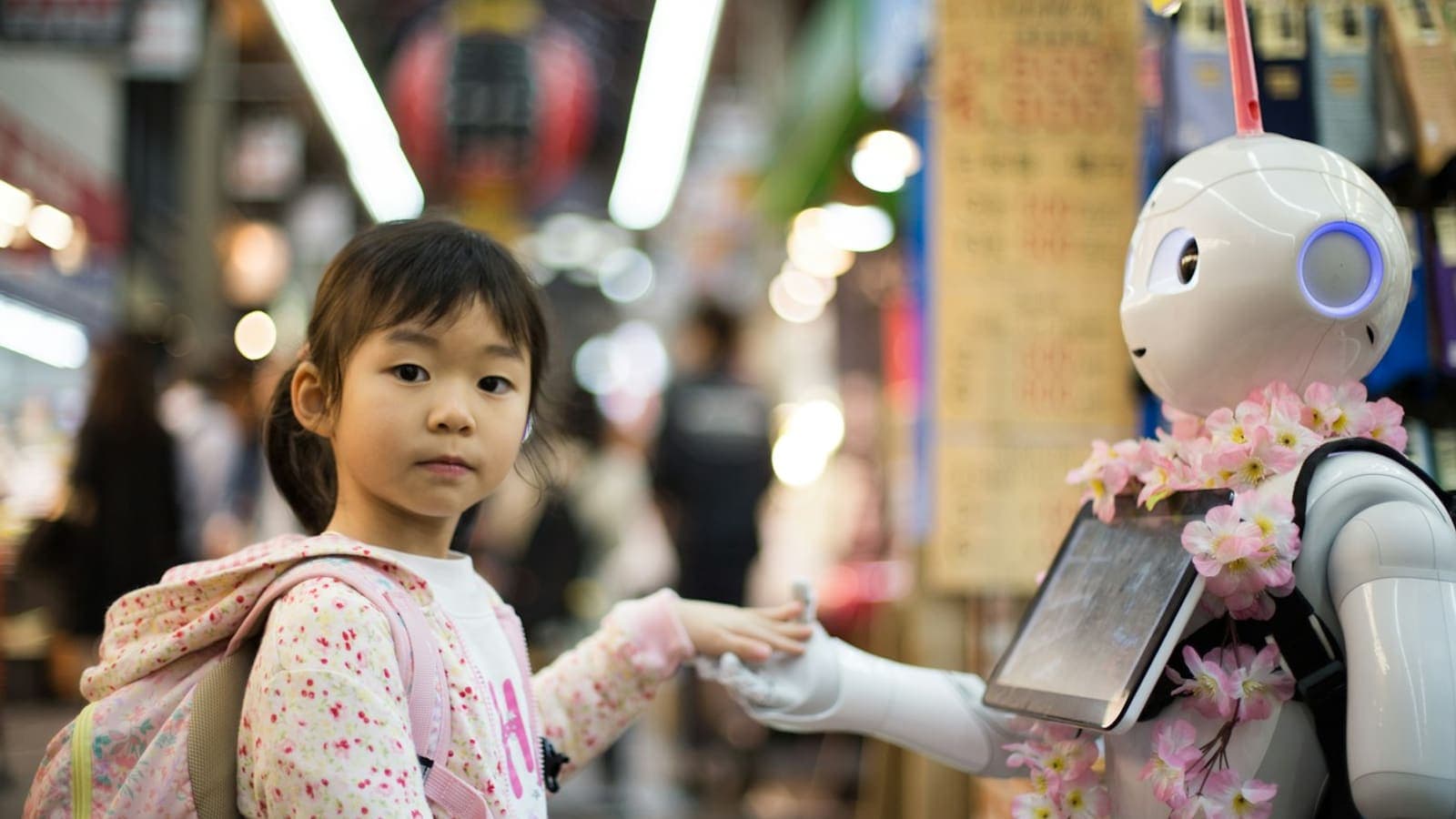
A young girl in a pink floral jacket and backpack holds the hand of a white humanoid robot decorated with pink blossoms in a busy market
Much of the evidence is about exposure, which differs from job loss. In January 2024 the IMF estimated that about 60 percent of jobs in advanced economies, around 40 percent in emerging markets and around 26 percent in low-income countries are exposed to AI, meaning they contain tasks AI could affect for better or worse. Its conclusion was that in most scenarios AI would likely worsen overall inequality. Employment data is more recent and less dramatic. The Stanford Digital Economy Lab paper "Canaries in the Coal Mine", revised in August 2026, uses US payroll data through June 2026. It finds no evidence of widespread job displacement across the economy. It does find that employment of 22 to 25 year olds in AI-exposed occupations is 19 percent below where it would be had it kept pace with less exposed peers, mainly through fewer hires. The authors call this an early, descriptive signal and not a causal estimate, and some of the divergence predates generative AI. The International AI Safety Report 2026 agrees: US and Danish studies found no clear link between exposure and overall employment, while others found falling employment for early-career workers in exposed jobs. Put together, the early effect shows up as fewer entry-level openings, and the data does not show mass layoffs. That matters to students like me. The business side for software companies is in is SaaS dying. Misinformation is the most visible. The International AI Safety Report 2026 notes that harmful incidents involving AI-generated content have risen substantially since 2021, that one study estimated 96 percent of deepfake videos online are pornographic, and that people in studies mistook AI text for human writing 77 percent of the time and AI voices for real ones 80 percent of the time. Watermarks can often be removed. Bias predates chatbots. Obermeyer and colleagues showed in Science in 2019 that a US health algorithm used past spending as a stand-in for medical need. Because less was spent on Black patients with the same level of illness, the system ranked them as healthier. The authors estimated that fixing the label would raise the share of Black patients flagged for extra care from 17.7 percent to 46.5 percent. The model predicted cost accurately, so standard accuracy checks missed the problem. Checking outcomes for different groups is what caught it. Privacy has produced real enforcement. In December 2024 Italy's data protection authority, the Garante, fined OpenAI 15 million euros for training ChatGPT on personal data without an adequate legal basis and for transparency failures. OpenAI said it would appeal, and no outcome turned up in my search. Security evidence is the least settled. The same report says AI agents have found software vulnerabilities at expert-competitive levels, with one system finding 77 percent of the vulnerabilities in real software in a major competition. Fully autonomous end-to-end attacks have not been reported, and it is unclear whether AI helps attackers or defenders more. Reliability first. The safety report says general-purpose AI can fail unpredictably, producing false information, flawed code or misleading medical advice, and that no combination of current methods eliminates failures entirely. Benchmarks also often fail to predict real-world performance, so an answer needs a check proportional to the cost of being wrong. Energy is easier to measure than most risks, though still uncertain. According to the International Energy Agency's Energy and AI analysis, data centres used about 415 TWh in 2024, roughly 1.5 percent of global electricity. Its base case reaches about 945 TWh by 2030, just under 3 percent, with scenarios from a plateau near 700 TWh to more than 1,700 TWh by 2035 and a warning that uncertainty is substantial. In the US, a Lawrence Berkeley National Laboratory report from December 2024, summarised by the Department of Energy, put data centres at about 4.4 percent of national electricity in 2023 and projected 6.7 to 12 percent by 2028. Water is harder still. Drawing on the same Berkeley Lab report, researchers writing in The Conversation in 2025 put US data centre cooling at about 17 billion gallons in 2023, plus about 211 billion gallons used indirectly through electricity generation. They stress that companies rarely disclose site-level figures and that cooling design changes the answer a lot: one Google site used about a billion gallons in 2024 and an air-cooled one about 10,000. These are modelled estimates, and the water cost depends on local cooling choices and local scarcity. On concentration, the Stanford AI Index 2025 reports that nearly 90 percent of notable AI models in 2024 came from industry, up from about 60 percent in 2023. Training the largest models takes data, chips and capital that few organisations have. For the money side, see who could become the next trillion-dollar AI company. Copyright is being settled case by case. In Bartz v. Anthropic, a US district court ruled in June 2025 that training on lawfully acquired books was fair use, but that keeping millions of pirated books in a central library was not. The case ended in a settlement of about 1.5 billion US dollars, roughly 3,000 US dollars per book for nearly 465,000 works, which reports say a judge approved in July 2026. Some authors and publishers opted out and are suing separately. One court's ruling on one set of facts does not settle whether training on copyrighted work is lawful elsewhere. Over-reliance is the quietest risk. The Turkish maths study shows a shortcut replacing practice, and the METR result shows a tool feeling fast while being slower. For programmers, developer skills to learn in the AI era looks at how to keep learning. The EU has the most complete law. According to the European Commission's AI Act page, the Act entered into force on 1 August 2024, banned practices and AI literacy duties applied from 2 February 2025, and rules for general-purpose AI models from 2 August 2025. Transparency rules, including labelling of deepfakes, start in August 2026. A package called the AI Omnibus, which entered into force on 27 July 2026, delayed the high-risk rules: use cases such as employment, education and biometrics now apply from 2 December 2027, and AI built into regulated products from 2 August 2028. It also added a ban on AI nudification and child sexual abuse material tools, effective December 2026. Some transparency duties have transition periods, so check the official text for your case. Elsewhere the picture is fragmented. In the US, an executive order of 11 December 2025 directed the Justice Department to challenge state AI laws. A Gibson Dunn analysis called it mostly a call for further agency action that does not itself override state law. China's measures requiring visible and embedded labels on AI-generated content took effect on 1 September 2025, according to law firm commentary. Less than headlines suggest on the near-term problems, more on the long-term ones. A Pew Research Center survey of 1,013 US AI experts (August to October 2024) and 5,410 US adults found that 51 percent of adults were more concerned than excited, against 15 percent of experts. Yet both groups worried more that regulation would fall short than that it would go too far, and majorities of both doubted that companies would act responsibly. Three camps deserve a fair statement. Optimists point to results like AlphaFold and the support-agent study and argue that benefits compound while harms can be managed. Sceptics, such as Narayanan and Kapoor in their essay "AI as Normal Technology", argue that adoption will be slow and shaped by institutions like earlier technologies, that benchmarks overstate real-world ability, and that inequality, labour disruption and concentrated power are the pressing problems. Safety researchers such as Geoffrey Hinton and Yoshua Bengio take seriously that future systems could be hard to control, while others such as Yann LeCun reject that framing. The International AI Safety Report says experts disagree sharply on the likelihood of losing control and that forecasts to 2030 range from modest gains to rapid ones. Each camp can defend its position with evidence and weighs the uncertainty differently. For individuals, it starts with treating output as a draft from a fast, sometimes wrong assistant. For businesses, it means knowing where AI touches customers or decisions. GoCart, a multi-vendor e-commerce project built for my final year (details here), has AI features still in development, so the developer items below are still being worked out and none of them is a lesson from a launch.
Text
RESPONSIBLE AI USE: A PRACTICAL CHECKLIST

Individuals
[ ] Verify any fact, number, quote or citation before you rely on it
[ ] Do not paste passwords, client data or private documents into tools
    you have not checked the data policy of
[ ] Do the first attempt at skills you are learning yourself, then compare
[ ] Be sceptical of unexpected voice notes, videos and urgent requests
    (agree a code word with family or colleagues)

Businesses
[ ] List every place AI touches customers, hiring, pricing or credit
[ ] Keep a human who can override and who is accountable for the outcome
[ ] Tell people when they are talking to AI or reading AI content
[ ] Check what data the vendor keeps, trains on and where it is stored
[ ] Review outcomes by group (for example by gender or region), not only
    overall accuracy
[ ] Check your local rules (EU AI Act dates, data protection law)

Developers
[ ] Test on realistic and low-resource inputs, including Urdu or other
    local languages if your users write them
[ ] Log prompts and outputs, with sensitive data minimised
[ ] Treat model output as untrusted input: validate, escape, rate-limit
[ ] Give users a way to report errors and get a human
[ ] Re-test when the model version changes
[ ] Write down what the system must never be used for
Most of this is ordinary engineering and good business practice applied to a component that can be confidently wrong. I am a student developer who builds ordinary web software, so this is a modest view and no forecast. The evidence I trust most is the narrow, measured kind: protein structure prediction, the support-agent study, the Nigeria and Turkey education trials. They suggest AI helps most when the task is well defined, a person stays in the loop and the tool guides the user instead of just answering. I trust least any claim that stretches one early result across a decade, in either direction. The risks that look most concrete are the ones already here: false content, biased automated decisions, uneven job effects that start with entry-level work, and dependence on a few firms. The entry-level hiring data deserves more attention than it gets, because it can be measured now and it affects people starting out. Loss-of-control scenarios are beyond what I can judge, and serious experts disagree about them, so I take them seriously and ask for evidence at the same time. A replicated, larger finding that AI raises drug success rates would make me more optimistic about science. A sustained fall in hiring across all experience levels, or proof that regulation cannot keep pace, would make me more worried. Energy demand could land at either end of the IEA's range, and I do not know which. For a next step, pick the checklist group above that matches you and apply two items this week. I am Fawaz Israr, a full stack developer in Rahim Yar Khan, Pakistan, a final-year Computer Science student and I work in web development at Hadi Dev Lab. If you have a question about this post or a project that involves AI features, you can message me on WhatsApp or email. You can also see my work first. Cover photo from Unsplash.
Share this post: