Asia/Karachi
BlogNovember 1, 2026

NVIDIA's Future: AI Chip Demand, Risks and Competition

What the latest filings show, how strong the CUDA moat is, and what could go wrong
Fawaz Israr
NVIDIA's Future: AI Chip Demand, Risks and Competition
NVIDIA's future depends on one question: will spending on AI data centres keep growing faster than the cost of building them? In its quarter ended 26 July 2026, the company reported 89.0 billion dollars of Data Center revenue, so it is selling almost entirely into that boom. The moat around its products is real, and so are the risks, from customer concentration and export rules to memory supply and electricity. I am a final-year Computer Science student, and this post is my attempt to read the primary documents and lay out both sides. Every number carries a date because they will age quickly. NVIDIA's fiscal year runs ahead of the calendar, so its "second quarter of fiscal 2027" covers May to July 2026. Most people say "GPUs", but the product today is closer to a data centre sold in pieces. The chips (Blackwell, and now Vera Rubin, which NVIDIA says is ramping into full production) are one layer. Around them sit networking gear such as Spectrum-6 switches, CPUs (the release describes Vera as the first CPU built for AI agents), full rack-scale systems that partners such as CoreWeave, Google Cloud, Microsoft Azure and Oracle Cloud Infrastructure are running, and the software that ties it together. That software starts with CUDA, the programming platform that lets developers write code for NVIDIA GPUs in languages such as C++ and Python. On top of it sit libraries (NVIDIA groups many under the name CUDA-X) and support in frameworks like PyTorch, according to NVIDIA's CUDA page. The latest results also list a Groq 3 LPX inference accelerator as in full production, a sign that NVIDIA is broadening beyond classic GPUs. According to NVIDIA's results release for the second quarter of fiscal 2027, published on 26 August 2026, quarterly revenue was 96.2 billion dollars, up 106 percent from a year earlier. Data Center was 89.0 billion dollars of that (up 117 percent), which works out to about 92.5 percent of the total by my arithmetic. A segment NVIDIA now calls Edge Computing, covering workstations, PCs, automotive and robotics, brought in 7.2 billion dollars. Gross margin was 75.0 percent, and guidance for the next quarter was 108.0 billion dollars, give or take 2 percent. For scale, NVIDIA's fiscal 2026 release from 25 February 2026 reported full-year revenue of 215.9 billion dollars, up 65 percent, with Data Center at 193.7 billion dollars. One quarter of fiscal 2027 is now nearly half of that full year. The CFO commentary filed with the SEC splits Data Center into two groups. Hyperscale customers contributed 48.7 billion dollars (about 55 percent, up 102 percent year on year). A group NVIDIA calls AI Clouds, Industrial and Enterprise contributed 40.3 billion dollars (about 45 percent, up 138 percent). NVIDIA says the second group is driven by AI-native companies, enterprises and sovereign customers. It also moved one customer between groups and restated earlier periods, so compare carefully. Training a frontier model needs enormous clusters, and the companies building them have been in a race. The newer driver is inference, the act of running a model to answer a request. Reasoning models and AI agents tend to spend far more computation per task than a plain chatbot reply. NVIDIA's chief executive described tokens as "productive and profitable" in the August release, which is a company claim, though the capex figures below show customers acting as if it were true. Spending by the large cloud companies is the clearest evidence. Amazon told investors, as reported by CNBC on 29 October 2026, that its quarterly capital spending was 77.3 billion dollars (against 35.1 billion dollars a year earlier) and that it still expects about 220 billion dollars this year. CNBC's report on Meta from 21 October 2026 says Meta narrowed its 2026 data-centre-related capital spending range to between 135 and 145 billion dollars. Alphabet's third-quarter release shows 51.4 billion dollars of purchases of property and equipment in the quarter, with its chief executive citing "huge demand" for AI infrastructure. Not all of that money goes to NVIDIA, because capex also covers buildings, power equipment and the companies' own chips. CNBC's Meta report also cites an analyst expectation of around 1 trillion dollars in combined hyperscaler capex next year, which is a forecast and no commitment. For the wider picture of what this build-out means, see my post on the benefits and risks of AI. The moat has three layers that age differently. The first is software. Many years of libraries, tutorials and engineers trained on CUDA mean a team moving to another vendor must re-tune its code and then trust the new stack in production. Most developers never touch CUDA directly, since PyTorch and similar frameworks sit above it, and those frameworks tend to be tuned hardest for NVIDIA hardware. My inference is that switching costs are lower than they look for common models and higher for unusual ones. The second is networking and systems. Training and serving large models means thousands of chips acting as one machine, so the links between them matter as much as the chips. NVIDIA sells the switches and the rack design, and its release cites Blackwell leading the MLPerf Training 6.0 benchmarks. A competitor has to match the whole system, and the chip is only one part of it. The third is supply. The filing shows NVIDIA's supply and capacity commitments rose to 279 billion dollars from 119 billion dollars one quarter earlier, "primarily related to the procurement of memory", per the CFO commentary above. Locking up scarce components ahead of rivals is an advantage, and also a liability if demand drops. How durable is all this? My reading is that the software layer erodes slowly, and large buyers are paying to speed that up. AMD's announcement with Anthropic, covered next, includes a multiyear collaboration on optimising AMD's ROCm software using Claude. If AI makes porting code cheap, that is a genuine threat to a software moat. Competition comes in four groups. AMD is the closest like-for-like rival. Its second-quarter 2026 results, released on 4 August 2026, show Data Center segment revenue of 6.7 billion dollars, up 107 percent. That segment includes server CPUs as well as Instinct GPUs, and it is roughly one thirteenth of NVIDIA's Data Center figure, so the gap is large. Even so, AMD launched its MI400 series and Helios rack, and announced a partnership with Anthropic for up to 2 gigawatts of MI450 GPUs. Its October 2025 agreement with OpenAI covers 6 gigawatts across several GPU generations, with the first 1 gigawatt due to begin in the second half of 2026. Customers of that size can make a second source real. Custom chips from the cloud companies are the second group. Alphabet's release says TPU systems were a meaningful contributor to its revenue growth. Amazon's chief executive said its Trainium chips business keeps growing at triple-digit percentages year on year, and Amazon plans to offer Trainium externally late in 2027. Anthropic's October 2025 announcement described using three chip platforms, Google's TPUs, Amazon's Trainium and NVIDIA GPUs, with up to one million TPUs and well over a gigawatt of capacity coming online in 2026. A top AI lab deliberately running on three architectures is the clearest sign that buyers want bargaining power. Startups are the third group. I did not find reliable revenue figures for them, but NVIDIA's own Groq 3 LPX accelerator for interactive inference suggests it takes specialised designs seriously. China is the fourth. NVIDIA's own filing says Hopper shipments to China were less than 1 percent of Data Center revenue in the quarter, and that its outlook assumes no China Data Center compute revenue. I could not verify from a good source how much Chinese suppliers such as Huawei are filling that gap, so I will not guess a figure. Customer concentration comes first. NVIDIA's 10-Q filing says that at 26 July 2026, five direct customers accounted for 22, 14, 13, 11 and 10 percent of accounts receivable. Direct customers are not always the final buyer, so this does not map neatly onto the big cloud companies, but a handful of buyers clearly carry a large share of the business. Export controls and geopolitics come next. A US Commerce Department rule published in the Federal Register on 15 January 2026 moved licence reviews for certain advanced chips to China to a case-by-case basis. That loosened policy somewhat, but rules can change again, China can refuse imports, and NVIDIA's guidance already assumes nothing from there. Supply is the third. The jump in memory commitments shows how tight that part of the chain is. The CFO commentary also says slower consumer PC sales, hit by higher memory and systems prices, partly offset growth in the Edge Computing segment, so memory costs are already squeezing another business. Inventory also rose to 31.6 billion dollars, from 21.4 billion dollars in January, per NVIDIA's release, which would hurt if demand cooled. Efficiency is the fourth. In January 2025 DeepSeek's cheaper reasoning model prompted a sell-off in NVIDIA shares, with some claiming it proved less hardware would be needed. The Motley Fool's write-up notes that DeepSeek's 5.6 million dollars cost figure was unverified, that analysts estimated far larger GPU spending, and that Microsoft's chief executive pointed to Jevons paradox, the idea that cheaper use leads to more use. Rising capex since then supports that view so far, but it is no law: if demand per task falls faster than the number of tasks grows, compute needs could flatten. A capex slowdown is the fifth, and it is the most direct. Every dollar of that spending needs funding, and NVIDIA's release mentions compute financing partnerships with firms such as Apollo, BlackRock, Blackstone, Brookfield, Goldman Sachs and KKR, aiming to mobilise over 500 billion dollars of third-party capital, subject to definitive agreements. Its filing also describes guarantees capped at 105 billion dollars tied to a site in Pike County, Ohio with about 4.25 gigawatts of IT load. My inference, which neither document states, is that when a chip seller helps arrange or backstop its customers' money, a downturn could hit both sides at once. Power is the sixth. The International Energy Agency projects that data centre electricity use will more than double to around 945 TWh by 2030, with AI as the main driver. NVIDIA's filing treats securing land, power and buildings as a necessary step in the build-out, and power delays can hold back deliveries however many chips exist. Valuation expectations are the last. I am deliberately not quoting a share price or market value, but the logic is simple: when expectations are very high, a company can report excellent results and still disappoint. The strongest bull case runs like this. AI is moving from a few giant training runs to everyday inference by agents, which means demand compounds with usage. The buyer base is widening: the second Data Center group grew 138 percent year on year, and sovereign and enterprise buyers are arriving. NVIDIA sells a full system with a software ecosystem rivals are still catching up to, and it has committed to supply that others may struggle to get. Cloud companies describe demand for AI infrastructure as strong, which could mean years of shortage rather than a glut. If that holds, the current numbers are a starting point. I looked at the more extreme versions of this argument in my post on the next trillion-dollar company. The strongest bear case runs differently. Hardware booms have often been cyclical. Customers are building their own chips and buying from AMD to gain bargaining power, which pressures NVIDIA's margins even if its volumes stay high. A few buyers hold most of the exposure, some of the financing could be circular in my reading, and the physical inputs (memory, power, sites) cap how fast anyone can deploy. Efficiency gains and cheaper open models could mean fewer chips per unit of useful work. And a 75 percent gross margin invites every large customer to try to engineer its way out. Both can be partly right: NVIDIA keeps growing and stays the standard, while its share and margins drift as alternatives mature.
Text
Signals worth watching (my own checklist, not predictions)
- Hyperscaler capex guidance for next year: raised, flat or cut
- Share of Data Center revenue from the top direct customers
- Gross margin trend against the 74 to 75 percent range
- Memory and power constraints easing or tightening
- Large AI labs moving more workloads to TPU, Trainium or AMD
- Whether China returns to NVIDIA's guidance or stays at zero
- Price per token for model APIs: falling fast (more usage) or flat
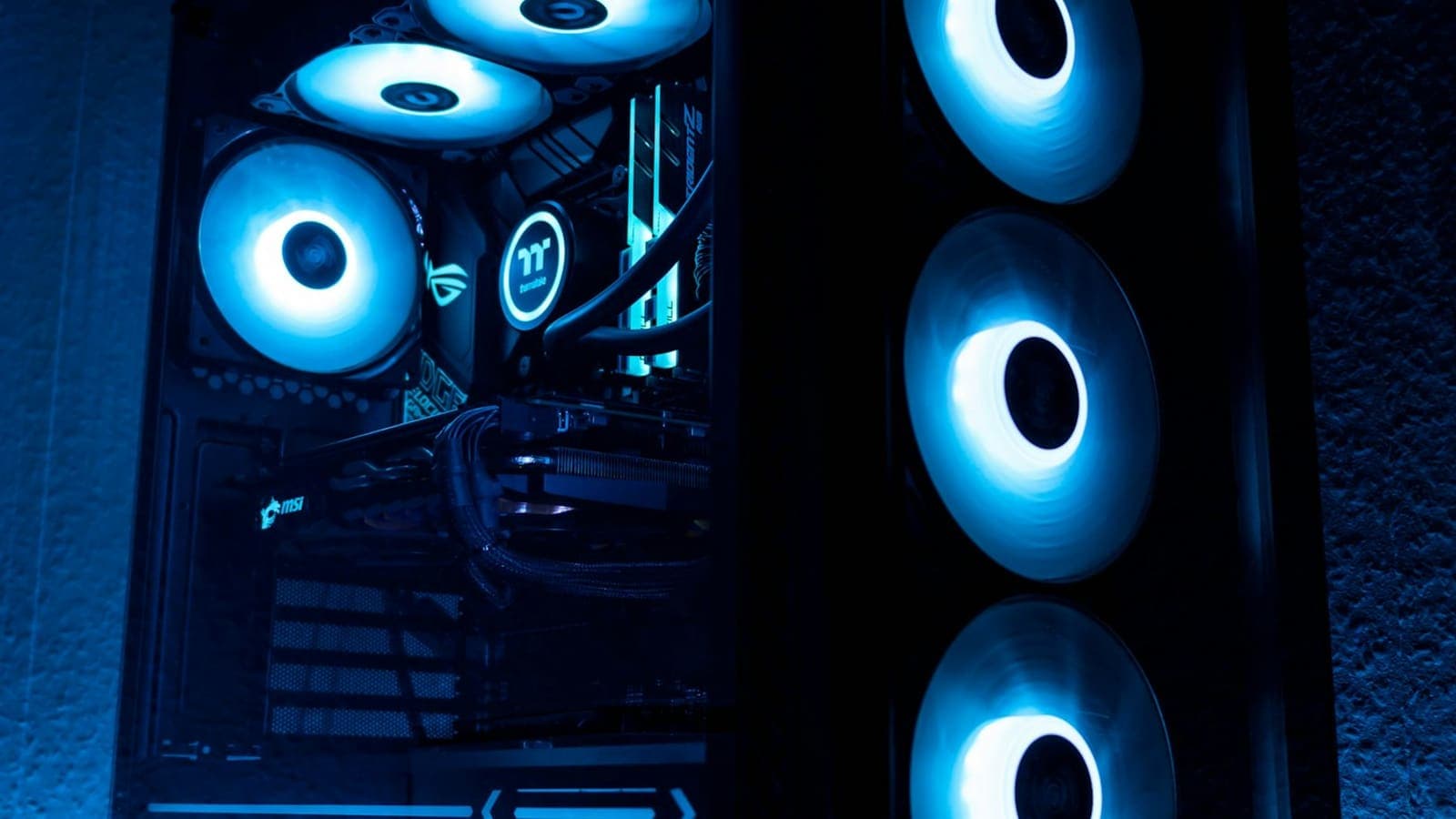
A dark computer case with glowing blue cooling fans around a graphics card, representing the GPU hardware inside AI servers
The first is inference itself. Products such as the Groq 3 LPX and the Vera CPU for agent workloads aim at the part of the market driven by usage. Networking is the second. The release highlights Spectrum-6 switch systems for AI factories. NVIDIA does not report a separate networking number in the documents I read, so I cannot size it. Robotics and automotive are the third. The Edge Computing release lists the DRIVE Hyperion robotaxi platform, Isaac GR00T for humanoids and Cosmos models for physical AI. Today that segment is 7.2 billion dollars a quarter and includes workstations and PCs, so robotics is still an early bet. The fourth is enterprise and sovereign deployment. The release names customers such as Apple (NVIDIA GPUs in its Private Cloud Compute) and SK Telecom, and the second Data Center group is growing faster than hyperscale. Many mid-sized buyers are slower to win than a few giants, but they reduce concentration. CUDA skills still have value, mostly at the edges. If you write inference servers, kernels or performance-critical code, knowing CUDA makes you rarer. If you build web apps on top of model APIs, you will probably never write a CUDA kernel. GPU cloud costs are where a developer feels NVIDIA's pricing power. When hardware is scarce, rental prices and API rates stay high, and when more competing chips arrive they tend to drop. I cannot predict the direction, so design for either: keep your code able to switch providers or models, and track cost per request from the start. For a project like GoCart, whose AI features are still in development, that means deciding early whether to call a hosted model API or run something yourself, and writing the integration so that decision can be reversed. Open model ecosystems matter too. Open-weight models that run on several kinds of hardware lower the cost of experimenting and make NVIDIA less of a gatekeeper, and AMD's ROCm collaboration points to a more portable software layer. On careers, I covered the bigger picture in will AI replace programmers and developer skills to learn in the AI era. The infrastructure spending is large, but the skills that last are evaluation, system design, data handling and shipping reliable software around model calls. I am a student developer, not an investor or analyst, so weigh this accordingly. What the documents support is that, as of August 2026, NVIDIA's growth was extraordinary and demand was still accelerating, and that its customers were openly building alternatives at the same time. Both things are in the sources. The moat looks strong for the next few years and weaker over a decade, mostly because the biggest buyers have both the money and the motive to reduce their dependence. What I cannot judge is the part that decides everything: whether AI revenue for NVIDIA's customers grows into the capex being spent. I do not have the training to forecast that, and nobody I have read has a reliable answer. The most useful evidence I found was that large cloud companies keep describing demand for AI infrastructure as strong, which would change quickly if it stopped being true. I would change my mind if the capex guidance for next year was cut, or if a top AI lab moved most of its new workloads off NVIDIA hardware. If I had to name the risk that gets the least attention in casual discussion, it would be physical limits: memory, power and construction. They slow deployment whatever the demand. This is not financial advice. For anyone building software today, my practical takeaway is small: keep your stack portable, measure AI costs per feature, and learn enough about the hardware layer to understand why your bill moves. You can read more about me on the about page. I am a full stack developer in Rahim Yar Khan, Pakistan, a final-year Computer Science student, and I work in web development at Hadi Dev Lab. If you are planning something that uses AI models and want a second opinion on the build, you can message me on WhatsApp or by email. You can also look through my work. Cover photo from Unsplash.
Share this post: