Asia/Karachi
BlogNovember 8, 2026

Palestine and Israel Explained: Comics, Facts and Sources

The history, the law, the children, the groups and the ways to help, told in eleven comic panels and five animated diagrams
Fawaz Israr
Palestine and Israel Explained: Comics, Facts and Sources
This guide explains Palestine and Israel in plain language, with eleven comic panels, five animated diagrams and a named source for every major claim. The core story the sources support is short: two peoples have claimed the same land, most Palestinians lost their homes in 1948 and many have lived under Israeli military control since 1967, and civilians on both sides have paid for the violence that followed, most recently since the Hamas-led attack of 7 October 2023 and the war in Gaza.
A wide banner in the colours of the Palestinian flag: wavy black, white and green stripes with a red triangle on the left. An olive branch with green leaves and dark olives lies across the triangle. In the centre a sand-coloured card reads Free Palestine in large friendly letters, with the Arabic words for free Palestine beneath in red and a small heart beside them. The stripes ripple slowly and the heart pulses gently.
Free Palestine. The approach is simple. Every number comes with a date and the name of whoever counted it. Where a word is contested, such as occupation, apartheid or genocide, the guide says who uses it and what a court has actually decided. Where historians disagree, it says so. All victims are counted. Israelis killed and taken hostage on 7 October 2023 were people, and so are the Palestinians who have lost their homes, their families and their safety. Criticism in this guide is aimed at governments, armies, policies and ideologies, never at people for their religion or ethnicity, and the guide names the officials, forces and groups that courts and UN bodies hold responsible for documented harm. Rumours and invented quotes weaken that record, which is why the guide also shows how to check a claim. Facts here are current to 8 November 2026. The situation changes weekly, so anything marked "as of" is a snapshot.
Text
If you only have two minutes
1. Until 1948 the land was called Palestine. Most people there were Arab, with a Jewish minority of about one third by the 1940s.
2. Britain promised a Jewish national home in 1917 without asking the people already living there.
3. In 1947 the UN proposed splitting the land. Jewish leaders accepted. Arab leaders rejected it.
4. In the 1948 war roughly 700,000 to 750,000 Palestinians fled or were driven out, and were never allowed back.
5. In 1967 Israel captured the West Bank, East Jerusalem and Gaza. Settlements, checkpoints and permits followed.
6. On 7 October 2023 Hamas-led gunmen killed about 1,200 people in Israel and took about 250 hostages.
7. Gaza's health ministry counts more than 74,000 Palestinians killed since then. A ceasefire began in October 2025 and is fragile.
8. The ICJ called the occupation unlawful in 2024. No court has yet decided whether genocide happened.
9. Check before you share, give to trusted groups, and name who is responsible using documented facts.
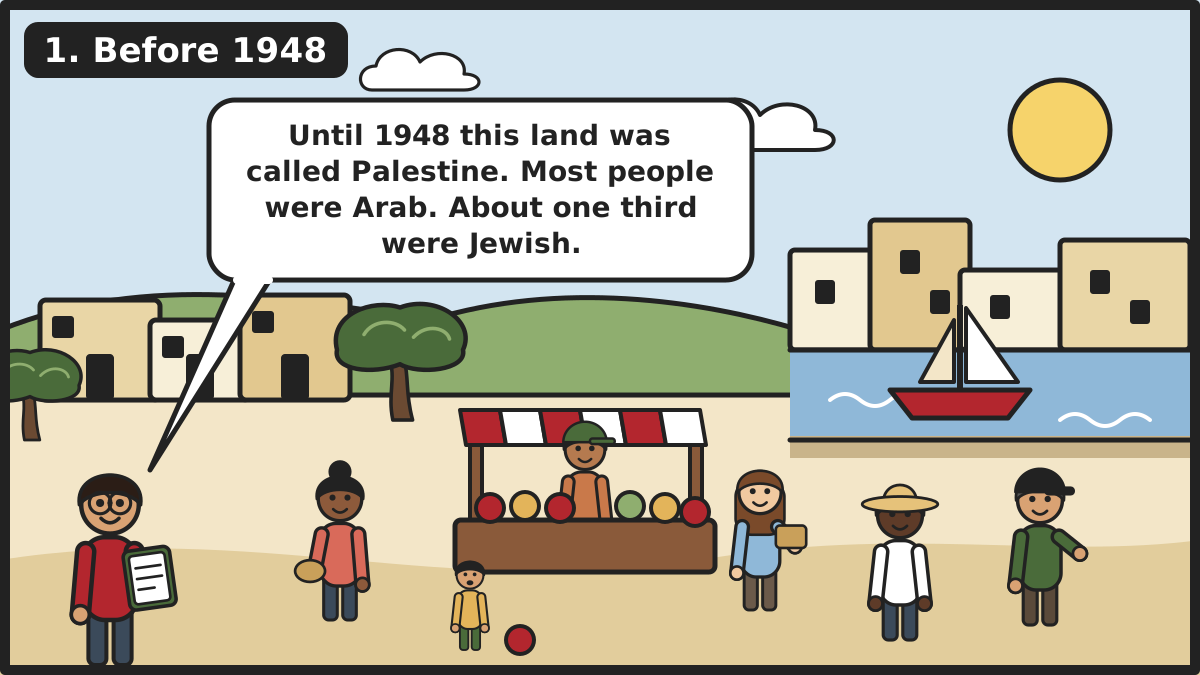
A sunny scene of a Palestinian village with stone houses and olive trees, a busy market stall with fruit, and a harbour town with a sailboat on the right. People of different skin tones and clothes shop and chat. A teenage narrator in a red hoodie with glasses and a notebook, who appears in most panels, stands at the left with a speech bubble saying that until 1948 this land was called Palestine, most people were Arab and about one third were Jewish.
Until 1948 the land was called Palestine. Under Ottoman and then British rule, most people living there were Arab, with a Jewish minority of about one third by the 1940s. Until 1917 the land was part of the Ottoman Empire. Just before the First World War, according to the Anglo-American Committee of Inquiry (which reported in 1946), about 689,000 people lived there, roughly 85,000 of them Jews. The rest were Arabic-speaking, mostly Muslim. Two national movements grew in this setting. Zionism, born in Europe in the late 1800s among Jews facing persecution, sought a Jewish homeland there. Arab nationalism sought independence from Ottoman rule. Britain promised Sharif Hussein of Mecca support for Arab independence in 1915 and 1916. Britain later said Palestine was excluded from that promise, and Arab leaders say it was included. On 2 November 1917 Britain's foreign secretary, Arthur Balfour, wrote that his government "view with favour the establishment in Palestine of a national home for the Jewish people". The letter added that "nothing shall be done which may prejudice the civil and religious rights of existing non-Jewish communities in Palestine". The existing majority is never named, only its civil and religious rights are protected, and its people were not consulted.
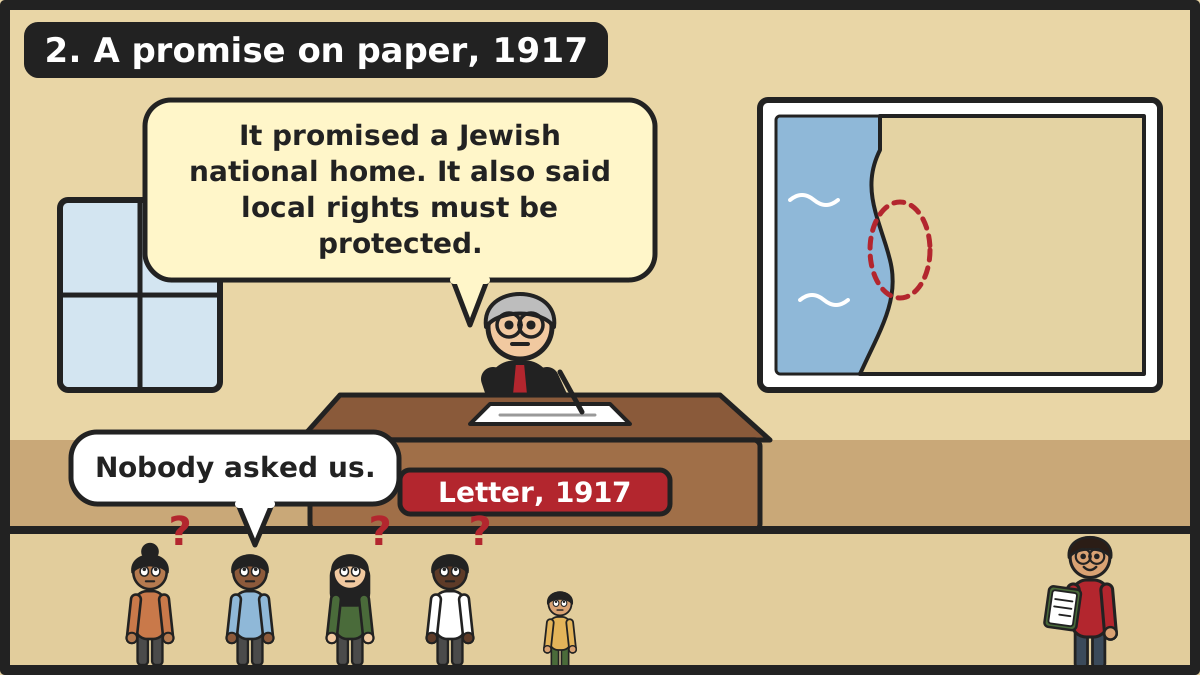
A British minister with grey hair and glasses sits behind a wooden desk signing a letter, with a red tag reading Letter, 1917. Behind him a framed wall map shows a coastline with a dashed red oval around the area of Palestine. Below, in a lower strip, five villagers of different ages look up with red question marks over their heads and a bubble saying Nobody asked us. The teenage narrator stands at the right.
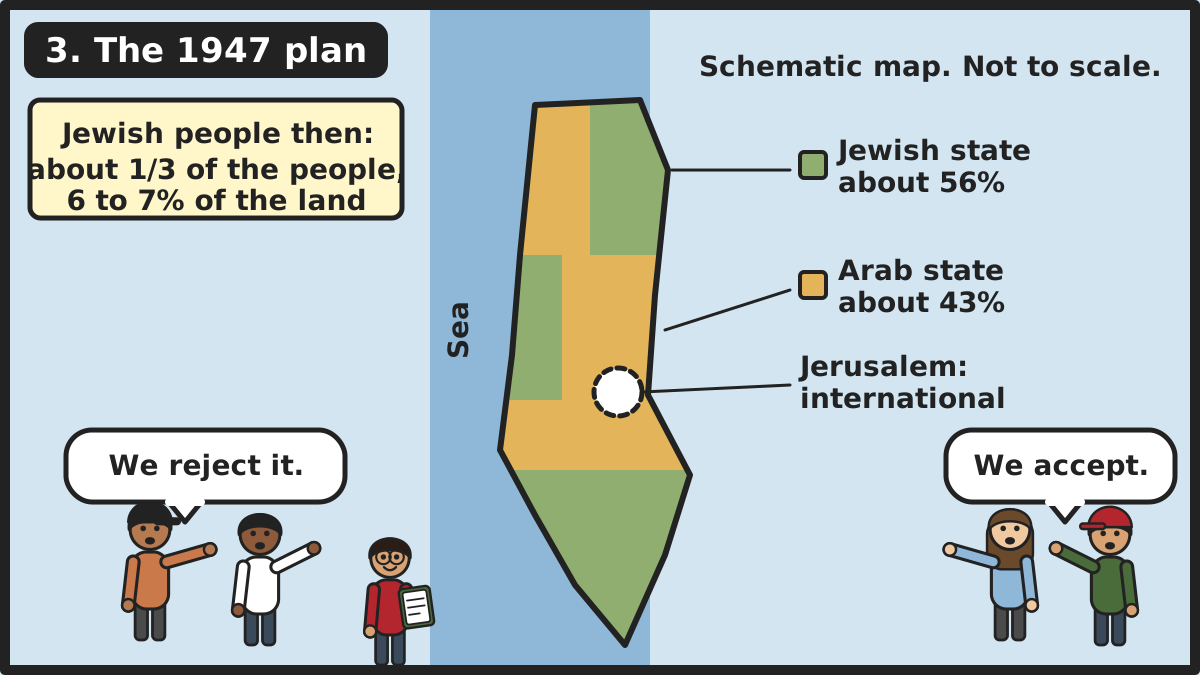
In 1917 Britain's Balfour Declaration promised a national home for the Jewish people in Palestine. It also said the rights of the people already living there must be protected. They were not asked. Britain then ruled under a League of Nations mandate approved in 1922, which told it to facilitate Jewish immigration and to safeguard the rights of all inhabitants. The Anglo-American Committee judged that the mandate was "framed primarily in the Jewish interest." The Jewish share of the population grew from slightly over 11 percent in 1922 to almost 28 percent in 1936, as Jews fled persecution in Europe. Arab leaders were alarmed, and riots broke out in 1920, 1921 and 1929. Land was the other pressure point. British statistics for 1945 put Jewish-owned land at about 1.49 million dunams, roughly 6 percent of the country and often rounded to 7. The Peel Commission of 1937 found the mandate unworkable and proposed partition, which Arab leaders refused. From 1936 to 1939 Palestinian Arabs rose in a general strike and then a rebellion, demanding self-government, an end to land sales to Jews and a halt to immigration. Britain crushed it. The historian Walid Khalidi, reading British figures, counts 5,032 Arabs dead. Several hundred Jews were also killed. Jewish armed groups grew in the same years, including the Haganah, the community's main force, and the Irgun and Lehi, which attacked British targets and, in the Irgun's case, Arab civilians. A British White Paper in 1939 limited Jewish immigration and land purchases, and the Zionist leadership rejected it. Britain handed the problem to the United Nations in 1947. On 29 November the General Assembly voted 33 to 13, with 10 abstentions, for Resolution 181. It proposed an Arab state of about 43 percent of the territory, a Jewish state of about 56 percent, and Jerusalem under international control. The UN estimated that the proposed Jewish state would hold about 498,000 Jews and 407,000 Arabs, and the Arab state about 725,000 Arabs and 10,000 Jews. The Jewish Agency accepted. The Irgun and Lehi opposed it. The Arab Higher Committee and the Arab League rejected it. Their stated reasons were that Arabs were about two thirds of the people and owned most of the land, that the plan overrode self-determination, and that a large Arab minority would sit inside the Jewish state. Jews were about one third of the population and owned roughly 6 to 7 percent of the land. Supporters of the plan answered that Holocaust survivors needed a refuge and that an Arab state was on offer.
A simplified, tall schematic map beside a strip of sea, split into green and ochre zones with a small white dashed circle for Jerusalem. A legend reads Jewish state about 56 percent, Arab state about 43 percent, and Jerusalem international. A note says Jewish people were then about one third of the people and owned about 6 to 7 percent of the land. Two people on the left say We reject it, and two on the right say We accept. The map is labelled Schematic map, not to scale.
In 1947 the UN proposed splitting the land: about 56% for a Jewish state and about 43% for an Arab state, with Jerusalem international. Jewish leaders accepted. Arab leaders rejected it, as Jewish people were about one third of the population and owned roughly 6 to 7% of the land. Fighting began almost at once. Israel declared independence on 14 May 1948, and the next day Egypt, Transjordan, Syria and Iraq sent armies in. By the 1949 armistices Israel held about 78 percent of former Mandate Palestine. Jordan took the West Bank and East Jerusalem, and Egypt took Gaza. About 6,373 Israelis died, the figure commonly cited. The Nakba, "the catastrophe", is the Palestinian name for the mass displacement. The UN says 700,000 Palestinians became refugees, and later UN statements say about 750,000. The Israeli historian Benny Morris gives a range of 600,000 to 760,000. Counts of emptied places also differ: about 400 villages and towns (Morris), 418 villages (Walid Khalidi) and 531 (other Palestinian researchers). A fair summary is roughly 700,000 to 750,000 people and several hundred villages.
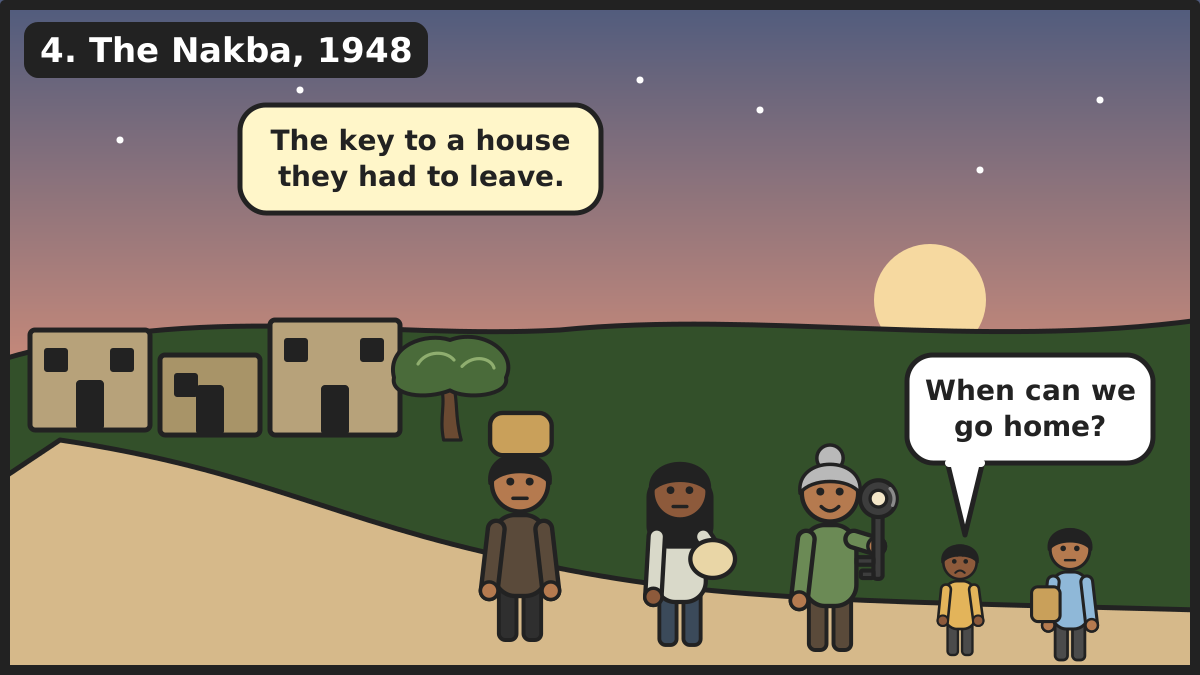
A dusk scene with a purple and orange sky, a rising moon and stars. On the left an empty village of dark-windowed stone houses and an olive tree. A family walks along a road in the foreground carrying bundles, one on a head. An older woman with a grey bun holds up a large old iron key. A small child with a worried face asks in a speech bubble, When can we go home? A narration box says it is the key to a house they had to leave.
In the war around Israel's creation in 1948, roughly 700,000 to 750,000 Palestinians fled or were driven from their homes, and hundreds of villages were emptied. This is called the Nakba, 'the catastrophe'. Refugees were never allowed back. Historians still debate how much was fear, flight or expulsion, but not the outcome. Historians disagree on why. Morris finds no pre-war plan to expel Arabs and says the Haganah's March 1948 Plan Dalet was not a political blueprint for expulsion. He also finds that from April 1948 an "atmosphere of transfer" took hold, that many communities were expelled, and that all of the refugees were in effect displaced for good because Israel barred their return. Ilan Pappe argues that Plan Dalet was a master plan for ethnic cleansing. Avi Shlaim writes that the single most important reason was Israeli political, military and psychological pressure. Israel's position is that the refugee problem came from a war the Arab side started by rejecting partition and invading, and that Arabs were invited to stay as citizens. About 150,000 did. On 11 December 1948 the General Assembly's Resolution 194 said refugees "wishing to return to their homes and live at peace with their neighbours should be permitted to do so at the earliest practicable date", with compensation for those who chose not to. Palestinians read it as a right of return, and Israel says it depends on peace and is not binding. Refugees have never been allowed back.
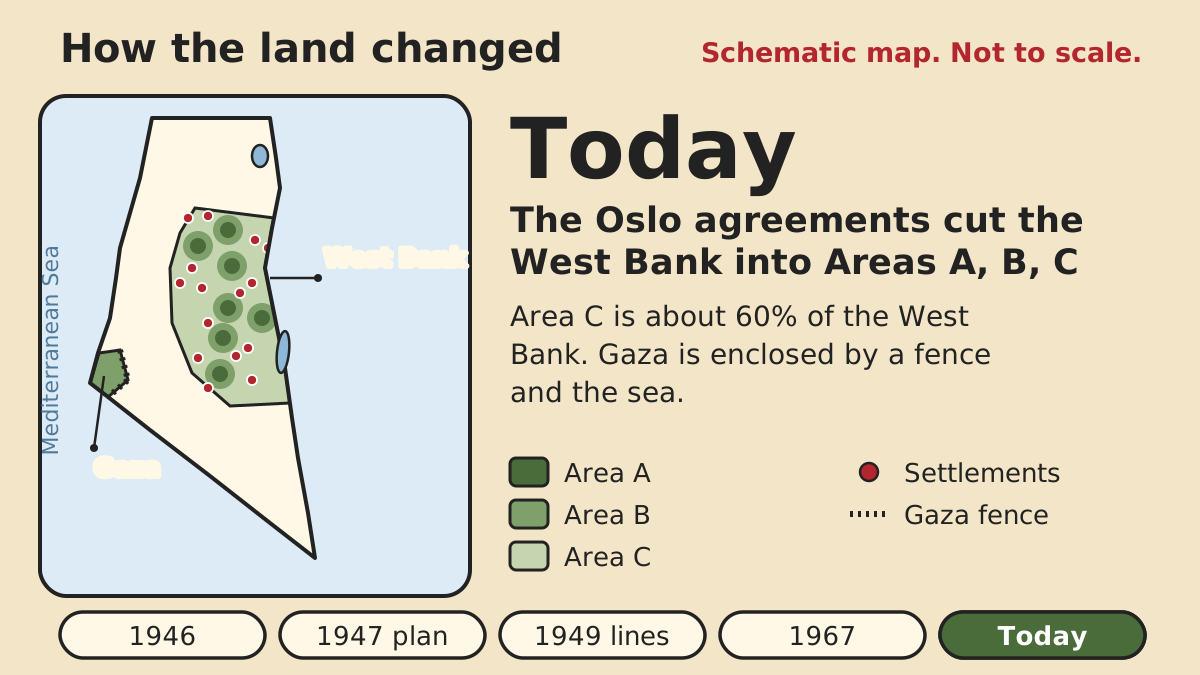
Animated schematic map, not to scale, that loops through five moments. 1946: one territory with small shaded patches for Jewish-owned land, about 6 to 7 percent. 1947: the UN partition plan with a proposed Jewish state, a proposed Arab state and an international Jerusalem. 1949: armistice lines with Israel, the West Bank under Jordan and Gaza under Egypt. 1967: Israel in control of all of it. Today: the West Bank split into Areas A, B and C, with Area C about 60 percent, settlements as dots and Gaza enclosed by a fence.
The same land at five moments between 1946 and today, drawn as a simple schematic that is not to scale. Most of the displaced lived first in tents in Gaza, the West Bank and neighbouring countries. The UN General Assembly created the UN Relief and Works Agency (UNRWA) in December 1949, and it began work on 1 May 1950. UNRWA's figures, as widely reported, are about 5.9 million registered Palestine refugees, counting descendants, with roughly a third living in 58 recognised camps. Many families kept the key to the house they left, and the key became a symbol of return. The Palestinians who stayed became Israeli citizens, but most lived under military government. State files published by Akevot show that about 85 percent of them were under it. It rested on British-era emergency regulations of 1945. People needed written permits to enter or leave closed zones, and some could be detained without trial. Israeli officials presented the system as a security measure. The archive also records other aims: controlling depopulated villages and their land, and stopping refugees from returning. The regime formally ended in December 1966, though Akevot's reading is that control continued by other means. Between 5 and 10 June 1967 Israel defeated Egypt, Jordan and Syria and took the Sinai, Gaza, the West Bank, East Jerusalem and the Golan Heights. Before the war, Egypt sent troops into Sinai, asked the UN force to leave and announced on 22 May that it would close the Straits of Tiran, according to the US State Department historian. Israel calls the war defensive, and historians still debate whether its strike on 5 June was unavoidable.
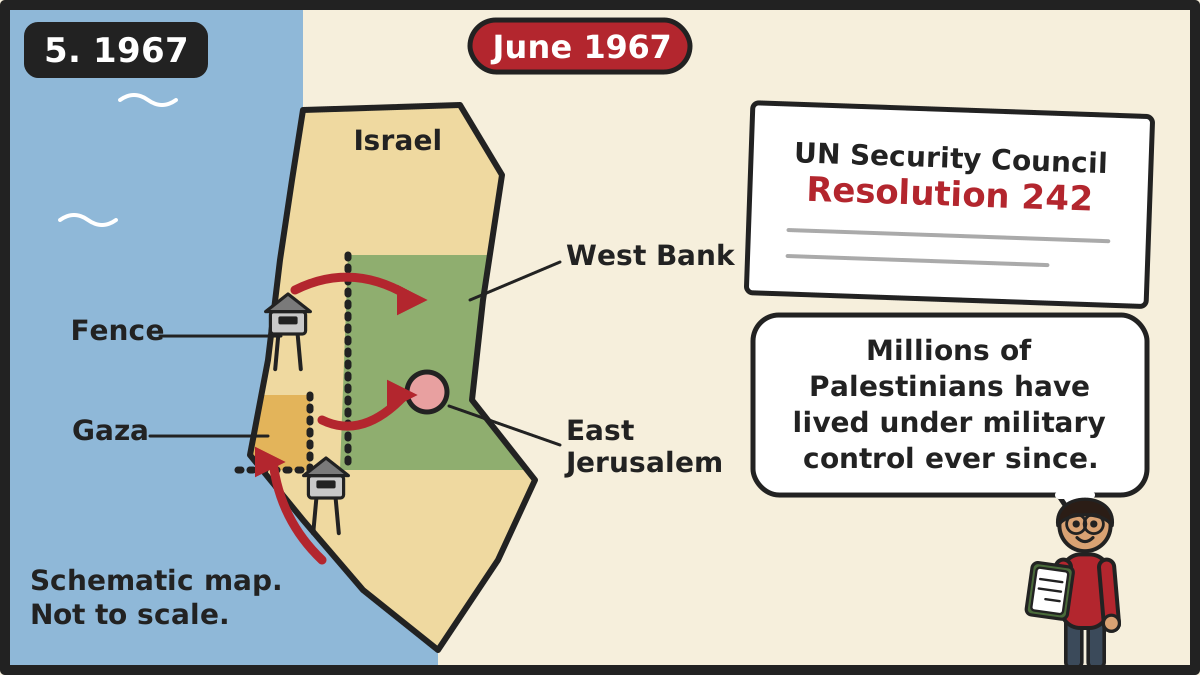
A simplified schematic map with the sea on the left and land in sand colour for Israel, a green block for the West Bank, a small ochre patch for Gaza and a pink circle for East Jerusalem. Red arrows point from Israel into those areas, dotted fence lines and two flagless watchtowers mark the borders, and a red tag reads June 1967. At the right a paper reads UN Security Council Resolution 242, and the narrator says millions of Palestinians have lived under military control ever since. The map is labelled Schematic map, not to scale.
In June 1967 Israel captured the West Bank, East Jerusalem and Gaza. Millions of Palestinians have lived under military control ever since. UN Security Council Resolution 242 called for Israeli withdrawal from territories occupied in the conflict. On 22 November 1967 the Security Council passed Resolution 242, which called for Israeli withdrawal "from territories occupied in the recent conflict". The English text has no "the" before "territories", while the French text says "des territoires". Israel and its supporters read the English as not requiring withdrawal from all the land. Palestinians and Arab states read it as requiring that. Israel soon decided to absorb East Jerusalem and began building civilian settlements in the occupied land. In July 2024 the International Court of Justice found that Israel's continued presence there is unlawful and that its settlement policy breaks international law. Settlers live under Israeli civil law, Palestinians nearby under military law. The First Intifada began on 9 December 1987, a day after an Israeli truck hit cars of Palestinian workers near the Erez crossing in Gaza and killed four. Palestinians saw it as deliberate, and Israel denied that. The uprising was mostly strikes, boycotts and stone throwing. Human Rights Watch called the military response disproportionate. Counts differ by who counts and where, but they run from roughly 1,100 to 1,500 Palestinians and from about 160 to 190 Israelis killed over six years. In 1988 the PLO leadership signalled that it would accept a Palestinian state alongside Israel. On 13 September 1993, on the White House lawn, Israeli Foreign Minister Shimon Peres and PLO official Mahmoud Abbas signed the Declaration of Principles, and Prime Minister Yitzhak Rabin and PLO chairman Yasser Arafat shook hands. Israel recognised the PLO, and the PLO renounced terrorism and recognised Israel. A Palestinian Authority would govern parts of the West Bank and Gaza for five years, and talks on borders, Jerusalem and refugees would follow, as the State Department historian summarises. The 1995 Oslo II agreement divided the West Bank. Area A, about 18 percent, came under Palestinian civil and security control. In Area B, about a fifth, Palestinians ran civil life and Israel kept security. Area C, over 60 percent, stayed under Israel, and UN OCHA says Israel keeps near exclusive control there over policing, planning and construction. The five years ended in 1999 with no final deal. Rabin was killed in November 1995 by Yigal Amir, an Israeli opponent of the accords. At Camp David in July 2000 President Clinton, Prime Minister Ehud Barak and Yasser Arafat failed to agree. Negotiators later blamed each other: Dennis Ross blamed Arafat, while Robert Malley argued that the offer fell short of Palestinian rights. Ariel Sharon's visit to the Temple Mount, known to Muslims as the Haram al-Sharif, on 28 September 2000 was followed by riots that grew into the Second Intifada, with suicide bombings in Israeli cities and Israeli military operations. In 2005 Israel removed its 21 Gaza settlements and its troops, moving 8,000 to 9,000 settlers depending on the source. Israel said this ended its occupation of Gaza. The UN, Palestinian officials and many legal scholars said it continued, arguing that Israel still controlled Gaza's borders, airspace and sea.
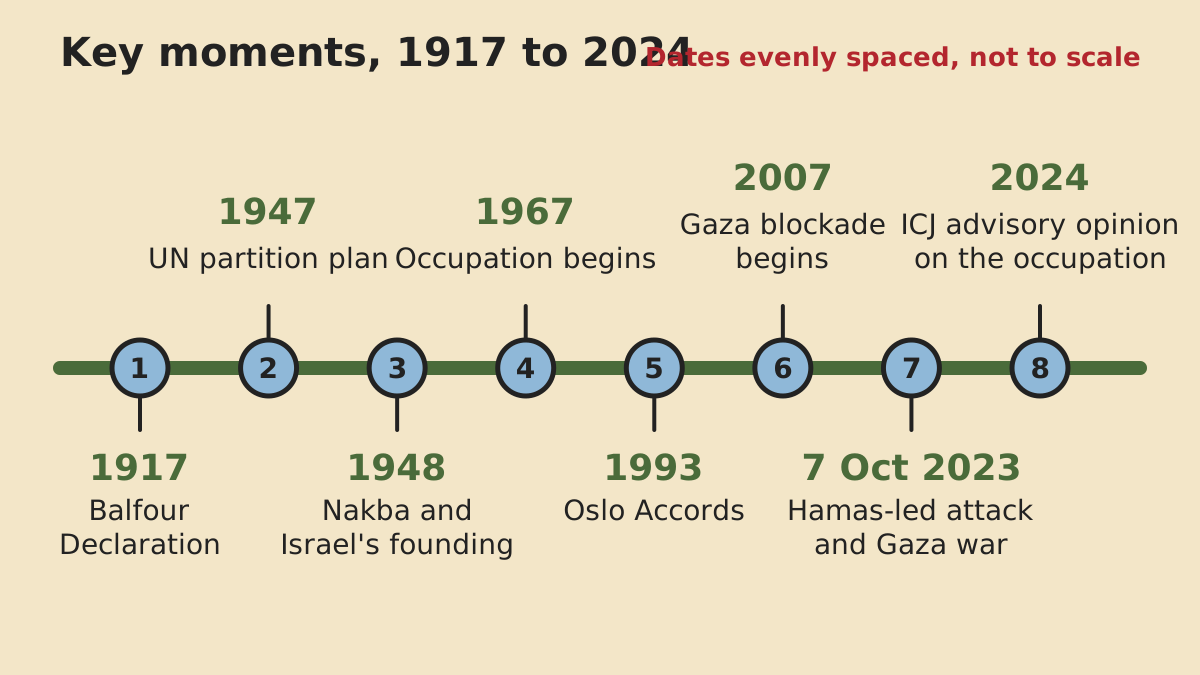
Animated timeline that draws itself from left to right with eight numbered markers: 1917 Balfour Declaration, 1947 UN partition plan, 1948 Nakba and Israel's founding, 1967 occupation begins, 1993 Oslo Accords, 2007 Gaza blockade begins, 7 October 2023 Hamas-led attack and Gaza war, and 2024 ICJ advisory opinion on the occupation. A note says the dates are evenly spaced and not to scale.
Eight dates from 1917 to 2024 that frame the history, from the Balfour Declaration to the 2024 ICJ advisory opinion on the occupation.
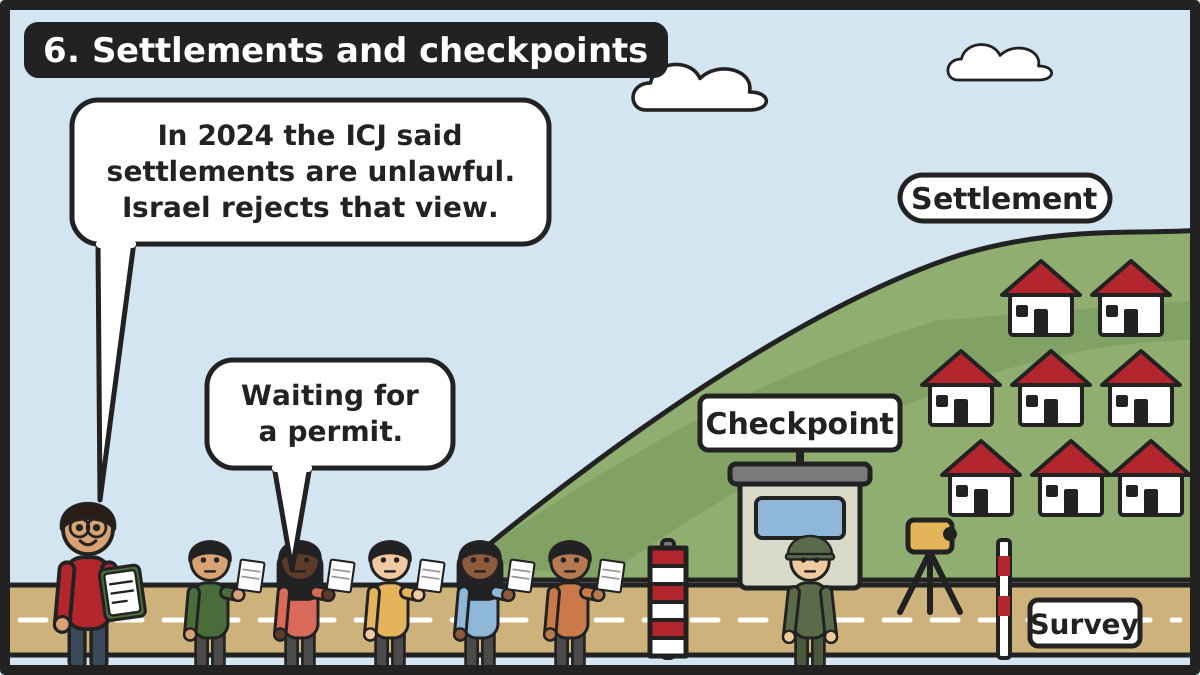
A green hillside on the right covered in rows of white houses with red roofs, labelled Settlement. Below it a road with a striped checkpoint barrier, a small booth with a generic uniformed guard in a helmet and a sign reading Checkpoint. Five people queue along the road holding paper permits, one saying Waiting for a permit. A surveyor's tripod and a sign reading Survey stand near the hill. The narrator says the ICJ said in 2024 that settlements are unlawful and Israel rejects that view.
Israel has built civilian settlements in the occupied West Bank, home to hundreds of thousands of settlers. The International Court of Justice said in 2024 that the occupation and settlements are unlawful. Israel rejects that view. More than 3 million people live in the West Bank, and Peace Now says about 85 percent of them are Palestinian. Settler counts differ by who counts and what is included. Human Rights Watch reported more than 710,000 settlers in the West Bank and East Jerusalem in 2023. An AP report in February 2025 cited a count by an advocacy group, West Bank Jewish Population Stats: 529,450 settlers at the end of 2024, not counting about 340,000 Jewish residents of East Jerusalem. Israel calls those East Jerusalem areas neighbourhoods of its capital. The UN calls them settlements. Peace Now counted 146 officially established settlements in the West Bank, excluding East Jerusalem, as of 1 August 2026. Outposts are built without formal approval. Human Rights Watch, citing Peace Now, reported that 248 new outposts had been set up under the current Israeli government, 65 of them in 2026 up to 1 August. UN OCHA documented 925 movement obstacles across the West Bank as of December 2025, 43% above the 20-year average, including 89 checkpoints staffed around the clock. The separation barrier is 712 km long and 64% built, and 85% of its route runs inside the West Bank, according to OCHA's April 2026 factsheet. The ICJ found in 2004 that the route inside occupied territory was contrary to international law. Only 3 of the barrier's 13 checkpoints can be used by Palestinians with West Bank IDs and permits to reach East Jerusalem and Israel, and OCHA says most permits have been revoked or suspended since 7 October 2023. OCHA's report of 22 October 2026 says about 1,790 Palestinians had been displaced since January by demolitions for lack of Israeli-issued building permits, including 668 in East Jerusalem. Settler violence is rising. For 2025, OCHA documented over 1,700 settler attacks causing casualties or property damage in more than 270 communities, and 232 Palestinians killed by Israeli forces or settlers in the West Bank, 52 of them children (to 8 December 2025). By 22 October 2026 the 2026 count of such attacks was already 2,159, and OCHA recorded 397 in the first 26 days of October, the highest monthly figure since it began counting in 2006. Human Rights Watch reported in August 2026 that settlers had killed at least 15 Palestinians that year as of 24 July. On 19 July 2024 the ICJ gave an advisory opinion at the UN General Assembly's request. It is not binding. By 11 votes to 4 the court found that Israel's continued presence in the Occupied Palestinian Territory is unlawful and must end as rapidly as possible. It also said that new settlement activity must stop immediately, that settlers must be evacuated, that Israel must make reparation, and that other states must not recognise the situation as legal or help maintain it. It found that Israeli laws and measures amount to systemic discrimination against Palestinians. Security Council Resolution 2334, adopted on 23 December 2016 by 14 votes with the United States abstaining, reaffirmed that settlements in territory occupied since 1967, including East Jerusalem, have no legal validity. Two legal systems operate in the West Bank. Human Rights Watch's 2021 report says Israel subjects Palestinians to military law while governing settlers under its civil law. Three organisations have called this apartheid. B'Tselem, an Israeli group, said on 12 January 2021 that Israel runs a regime advancing Jewish supremacy over Palestinians. Human Rights Watch concluded on 27 April 2021 that Israeli authorities commit the crimes against humanity of apartheid and persecution. Amnesty International said on 1 February 2022 that Israel enforces apartheid. These are findings by rights groups, not court rulings. Israel rejects both the ICJ opinion and the apartheid label, and says many of its policies respond to Palestinian violence. The Palestinian Authority was created under the Oslo agreements and runs some civil affairs in Areas A and B, while Israel keeps overall control. Many question its legitimacy: no presidential election has been held since 2005. On 10 October 2026 President Abbas cancelled legislative elections set for 28 November and rescheduled them for 11 September 2027, citing Israeli raids, settlement growth, settler violence and withheld revenues, according to the Jerusalem Post. On annexation, the Knesset passed preliminary readings of sovereignty bills in October 2025, and no final law had been reported as of November 2026. President Trump said in September 2025, "I will not allow Israel to annex the West Bank," and Vice President Vance called the parliamentary vote "a very stupid political stunt," according to CBS News. In February 2026 Israel's security cabinet approved measures to tighten control over Palestinian-run areas, including letting Jewish Israelis buy West Bank land directly. The government then approved registering Area C land, about 60% of the West Bank, as state property. Egypt, Qatar, Jordan and the EU condemned the steps, and critics call them de facto annexation. Zionism is a political movement for Jewish national self-determination in the land it calls Eretz Israel. It took organised form when Theodor Herzl convened the First Zionist Congress in Basel in August 1897. Its programme said Zionism "seeks to establish a home for the Jewish people in Eretz-Israel secured under public law." The movement had secular, socialist and religious strands. Religious Zionism, shaped by Rabbi Abraham Isaac Kook, organised through the Mizrachi movement in 1902. Christian Zionism is a separate movement. It began among Protestants centuries earlier, rests on Christian theology, and is strong today among American evangelicals. Zionism is a political idea and Judaism is a religion, so the two are different things. Jews hold every position. Many are Zionists, some are non-Zionists, and some are anti-Zionists. Jewish Voice for Peace, founded in the United States in 1996, declared itself anti-Zionist in 2019. Neturei Karta, a small ultra-Orthodox group founded in Jerusalem in 1938, opposes the state on religious grounds and is shunned by most other Jewish groups, including most anti-Zionist ones. Israeli organisations such as B'Tselem, Yesh Din and Breaking the Silence, a group of veteran soldiers, document abuses by their own state. Before 1948 two underground groups, the Irgun and Lehi, attacked British and Arab targets. The Irgun bombed the King David Hotel in Jerusalem on 22 July 1946 and killed 91 people: 41 Arabs, 28 British, 17 Jews and five others. The Jewish Agency condemned it. On 9 April 1948 Irgun and Lehi fighters attacked the village of Deir Yassin with Haganah support. A toll of 254 was long repeated, while later scholarship, including Benny Morris, puts it near 100 to 110. Witnesses described prisoners being shot. Lehi killed the UN mediator Folke Bernadotte on 17 September 1948, and David Ben-Gurion's government then outlawed it. Rabbi Meir Kahane's party Kach was disqualified from the 1988 election as racist. On 25 February 1994 a Kach member, Baruch Goldstein, shot dead 29 Palestinian worshippers at the Cave of the Patriarchs in Hebron. Israel's cabinet banned Kach and Kahane Chai on 13 March 1994. The United States listed Kahane Chai as a terrorist organisation in 1997 and removed it on 20 May 2022, saying it was no longer active. Kahanist ideas survive in some politics. Itamar Ben-Gvir was convicted in June 2007 of incitement to racism and of supporting a terrorist organisation, Kach, and later became national security minister. Most settler violence today comes from loose networks. The Hilltop Youth are young settlers who build outposts, and Lehava campaigns against Jewish-Arab relationships and the Christian presence. Its leader Benzi Gopstein was convicted in January 2024 of incitement to racism and cleared of four counts of incitement to terrorism and violence. The UN's humanitarian office, OCHA, counts more than seven settler attacks a day causing casualties or damage in 2026 up to 22 October, against five a day in 2025. The United States sanctioned Lehava in July 2024 under an order President Biden signed on 1 February 2024, and the State Department called it "the largest violent extremist organization in Israel." President Trump revoked that order on 20 January 2025, and no new US settler sanctions turned up for 2025 or 2026. The United Kingdom sanctioned Hilltop Youth and Lehava on 3 May 2024. The EU adopted asset freezes on four organisations and three people on 28 May 2026, according to press reports, and Australia, Canada, France, New Zealand, Norway and the United Kingdom announced joint measures against settlers on 9 June 2026. Israel's foreign minister called the EU step "arbitrary and political." Prosecutions are rare. Yesh Din's data sheet of 1 January 2026 says 93.6% of the files it monitored since 2005 on ideologically motivated offences by Israelis against Palestinians in the West Bank ended without an indictment, and 3% ended in a full or partial conviction. Yesh Din also says the police failed in the investigation of 82% of these files. Documented routes are mainstream. Military service is compulsory at 18 for Jewish men and women, and for Druze and Circassian men, while other Arab citizens are not conscripted. Religious Zionist men can choose hesder, a programme of about five years that mixes Torah study with shortened military service. Pre-military academies, called mechinot, run for about ten months. The first opened in 1988 in the settlement of Eli, a 2008 law gave them state recognition, and dozens now operate. No source found for this guide shows any of these routes teaching violence against civilians. Reporting describes the Hilltop Youth and Kahanist circles as networks that form around outposts, rather than as training programmes. The army is where rights groups see the problem. West Bank reserve units known as Hagmar draw heavily on local settlers, and the army said it had issued about 7,500 weapons to them by the end of 2024, the Times of Israel reported in June 2026. Yonatan Kanonich of Yesh Din told the paper, "You have a soldier who is also a settler operating in his own backyard." The army says these reservists receive the same training as others plus instruction on settler violence, and that dozens have been dismissed. Chief of Staff Eyal Zamir called settler attacks "morally and ethically unacceptable" in March 2026. Most Israeli Jews take no part in any of this. Israel itself banned Kach and Lehi, and its own army chief condemns settler violence. Holding a whole faith responsible is false and lets critics dismiss the documented abuses. The responsibility sits with the people who commit the attacks and the officials who fail to stop or prosecute them. Muslims use the name Al-Aqsa for the whole walled compound in Jerusalem's Old City, which holds the Al-Aqsa Mosque and the Dome of the Rock. Jews call the same hill the Temple Mount, the site of the two ancient Temples. The Western Wall below it is where Jews pray. After Israel took East Jerusalem in 1967 it left daily management to the Jerusalem Islamic Waqf, which works under Jordan's authority, and kept control of security and entry. Non-Muslims may visit at set hours, but only Muslims may pray. This unwritten arrangement is called the status quo. Jordan's role was recognised in the 1994 Israel-Jordan peace treaty, according to a 2022 history of the arrangement by Arab Center Washington DC, a Palestinian-authored study. Israel's official line has not moved. After Itamar Ben-Gvir, then national security minister, said he had prayed at the site in August 2025, Prime Minister Netanyahu said the policy "has not changed and will not change." On the ground, enforcement has loosened. In July 2024 Ben-Gvir told parliament: "I am the political echelon, and the political echelon allows Jewish prayer at Temple Mount." In January 2026 police let Jewish visitors carry printed prayer sheets for the first time, the Times of Israel reported. Beyadenu, a group that campaigns for Jewish access, counted 68,429 Jewish visits in the Hebrew year to September 2025, about 22% more than the year before. After Ben-Gvir visited in April 2026 and said "Today, I feel like the owner of the place here," Jordan's foreign ministry called it a violation of the status quo, "a condemnable escalation and an unacceptable provocation." The site has set off violence before. Hamas named its 7 October 2023 attack "Al-Aqsa Flood" and cited the mosque as a motive, Reuters reported. In 2026 Israel closed the compound to worshippers from 28 February, the day its war on Iran began, and reopened it on 9 April, citing security. Palestinian officials called the closure a pretext, and the Palestinian news agency WAFA said it was the longest since 1967. Middle East Eye then reported that Jewish visiting hours grew to six and a half hours a day. An organised movement wants a Jewish temple on the site. The Temple Institute prepares for it, and the Temple Mount Faithful tried to lay a cornerstone in 1990, which led to deadly riots. In 2022 a Jewish-Christian group called Boneh Israel flew five red heifers from Texas, with rabbis of the Temple Institute involved, the Jerusalem Post reported. Under Jewish law the ashes of an unblemished red heifer purify people who have touched the dead, a step the movement sees as needed before temple service. Partisan outlets later reported that the Texas animals were disqualified. No completed ritual is on record. One longtime activist, Boruch Fishman, told Middle East Eye in 2024: "All we want is a small altar." The Waqf's spokesman answered that "Al-Aqsa Mosque is for Muslims only." No cabinet decision to build anything on the site turned up. The Chief Rabbinate has forbidden entry since 1967 over ritual purity, and in 2020 135 national-religious rabbis reaffirmed the ban, so many leading rabbis oppose entering at all. An Israel Democracy Institute survey in 2022 found about half of Jewish Israelis backed Jewish prayer there, and 40% opposed. The only poll on building a temple that turned up was commissioned by temple groups in 2013: 30% in favour, 45% against, 25% unsure. No recent independent figure turned up. The Ark of the Covenant is the gold-covered chest that held the stone tablets, kept in the Holy of Holies. The Hebrew Bible does not say what became of it after Babylon destroyed Jerusalem in 586 or 587 BCE. Later texts disagree: 2 Maccabees, written around 100 BCE, says Jeremiah hid it in a cave on Mount Nebo. The Ethiopian Orthodox Church says it holds the Ark in Axum, and the scholar Edward Ullendorff, who examined the chest in 1941, reportedly said: "They have a wooden box, but it's empty." The Jerusalem digs are documented. In 1981 Rabbi Yehuda Getz, the Western Wall's rabbi, had a tunnel behind Warren's Gate cleared. His daughter said he was looking for the Ark, and in 1993 he wrote that "we know the exact location of the Ark." Andrew Lawler's account says Waqf workers came to seal it, and the government resealed the tunnel. Archaeologists regard the claim as fantastical, Lawler writes. In 1996 the opening of a new exit to the Western Wall Tunnel set off riots in which about 70 Palestinians and about 17 Israeli soldiers died, according to figures cited by Haaretz and PBS. No find has been verified, and any talk of a magic chest comes from belief. In Islamic tradition the Dajjal is a false messiah who appears before the Last Day. The best-known account is a narration in Sahih Muslim: a young man with a blind eye who appears between Syria and Iraq, calls people to a false religion, stays forty days, and is killed by Jesus at the gate of Ludd. Another narration, Sahih Muslim 2944, says seventy thousand Jews of Isfahan will follow him. It names followers in one place at one future time and does not describe any people of today. Some Muslim speakers link the Third Temple movement to these end-time reports. Some Christians and Jews tie the red heifer to their own expectations. The Christian rancher who raised the Texas heifers said "The red heifer is the key," and the Jerusalem Post noted that Maimonides wrote the next red heifer would be brought by the Messiah. These are readings of scripture, and none is evidence about what any government is doing. Many scholars urge restraint. Akram Nadwi, principal of the Al-Salam Institute, writes that there is "no reliable information about Dajjal that is sufficient responsibly to change your behavior or your policies," and that treating an event as a sign can make people misjudge the right response. Whether the Dajjal "is" a state, a system or a person is a dispute among believers. Claiming the Dajjal is the Jewish people, or that ordinary Jews are his followers, has no basis in those texts and puts the blame on people who have done nothing.
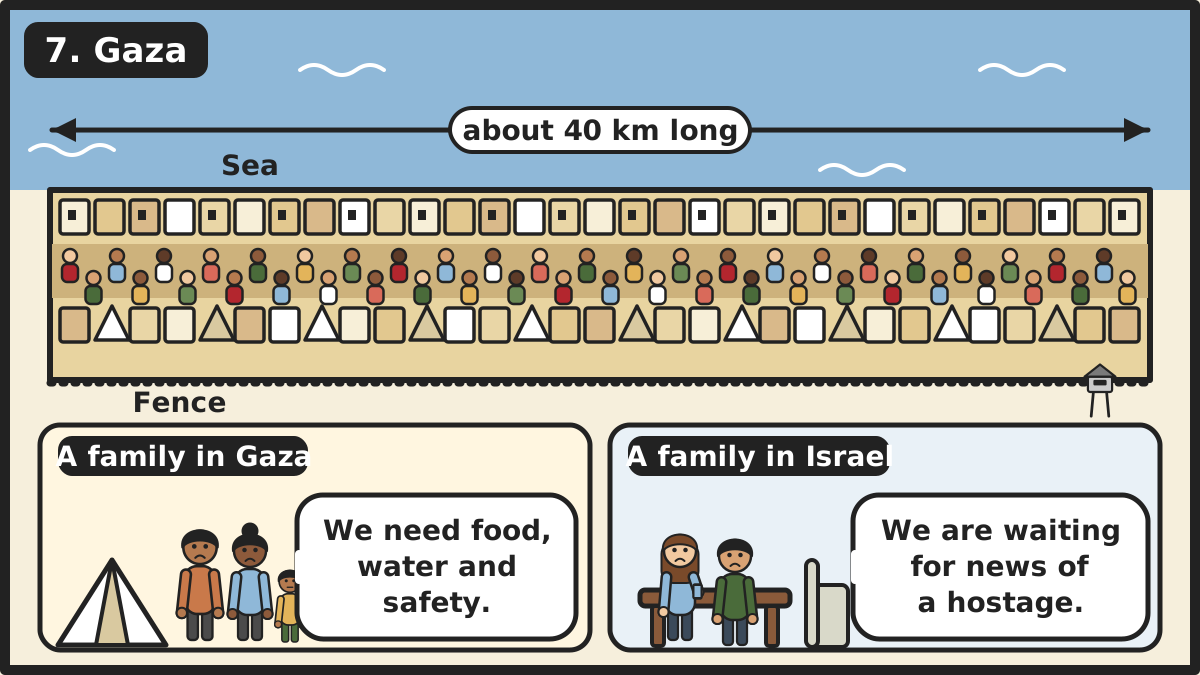
A long narrow rectangle labelled about 40 km long, drawn under a strip of sea, packed with small houses, tents and a crowded street of tiny people, with a dotted fence line and a flagless watchtower below it. Two framed scenes below: a family in Gaza by a tent, saying We need food, water and safety, and a family in Israel at a table with an empty chair and a phone, saying We are waiting for news of a hostage. No violence is shown.
About 2 million people live in Gaza, a strip about 40 km long, under an Israeli-led blockade since 2007. On 7 October 2023 a Hamas-led attack killed about 1,200 people in Israel and took about 250 hostages. Israel's war since then has killed tens of thousands of Palestinians, according to Gaza's health ministry and the UN, and left most of Gaza's people displaced and short of food and water. Gaza is a strip of land about 40 km long on the Mediterranean, bordered by Israel and Egypt. After Hamas took control there in June 2007, Israel tightened its land, sea and air restrictions, and Egypt restricted the Rafah crossing. Israel limits "dual-use" goods and cites security. The UN's humanitarian office describes the system as a blockade that has "raised concern about collective punishment and other possible violations" of international law. In June 2022 it reported unemployment of 46.6% and said 78% of piped water was unfit to drink. The law is contested. A 2011 UN panel (the Palmer report) found Israel's naval blockade lawful. Amnesty International replied that this did not cover the wider closure. Four rounds of fighting came before 2023. In 2008 and 2009 more than 1,400 people were killed, and a UN fact-finding mission led by Richard Goldstone found serious violations by both Israeli forces and Palestinian militants. In July and August 2014 the UN counted 2,251 Palestinians killed, 1,462 of them civilians, and six civilians and 67 soldiers killed in Israel. In May 2021, 256 Palestinians died in Gaza, including 66 children, and 13 people died in Israel. On 7 October 2023, Hamas-led gunmen crossed from Gaza into Israel and attacked towns, kibbutzim, army posts and an outdoor music festival. The UN's acting Middle East envoy has referred to "the horrific terror attacks of 7 October 2023". Israeli authorities count about 1,200 people killed, including foreign nationals. The UN humanitarian office, citing Israeli official sources, lists 1,162 identified dead, among them at least 33 children (as of 4 November 2026). About 251 people were taken to Gaza as hostages. By 15 October 2025, PBS reported that 168 had come home alive, including eight rescued by Israeli forces. The other 83 did not return alive. The last, police officer Ran Gvili, aged 24, was recovered on 26 January 2026 after more than 840 days. Israeli officials say no hostages remain in Gaza. The Gaza Ministry of Health, which operates under the de facto authorities, reports 74,618 people killed and 175,920 injured since 7 October 2023 (as of 4 November 2026, in the UN's latest impact snapshot). Of 74,237 deaths with full identification, the ministry lists 35,555 men, 21,976 children, 11,301 women and 5,405 elderly people. The ministry does not separate civilians from fighters, so "men" includes any combatants. The section on children below covers the UN's own counts. Independent work suggests the ministry undercounts. A household survey in The Lancet Global Health estimated 75,200 violent deaths between 7 October 2023 and 5 January 2025, with a range of 63,600 to 86,800, against about 49,090 reported by the ministry for that period. The study, published in February 2026, surveyed about 2,000 households and did not rely on ministry records. It is an estimate from a survey, so check the journal before quoting it. In a November 2024 report on the first six months, the UN human rights office reported verifying 8,119 deaths, nearly 70% of them women and children. Israel has not published a full breakdown of civilians and fighters among the dead. In January 2026 an unnamed military official told Israeli media the army also estimates about 71,000 dead, and the military then said this was not official data. Among those killed are 597 aid workers, including 403 UN-linked staff. For journalists, the Committee to Protect Journalists counted 189 Palestinians killed by Israel in Gaza as of 24 September 2026, while the Palestinian Journalists Syndicate reports 262. Counting is hard because foreign press are barred and communications are damaged. By the UN's figures, 76.6% of housing units were destroyed or damaged as of October 2025, and 93% of school buildings needed full rebuilding or major repair. Only 44 of 671 health facilities fully function (3 November 2026). About 1.98 million people need shelter help, and 65% of assessed households live in tents or makeshift shelters. In July 2024 the UN estimated that 1.9 million people, nine in ten, had been displaced. On 22 August 2025 the IPC, the global food security monitor, confirmed famine in Gaza Governorate, with 514,000 people in its worst category. Israel's government rejected the finding. On 19 December 2025 the IPC found no area still in famine after the ceasefire improved access, though 1.6 million people faced crisis-level hunger or worse. As of July 2026, the IPC expected more than 1.4 million people, 67%, to face that level through December. A first ceasefire began on 19 January 2025 and ended when fighting resumed on 18 March. A new agreement took effect on 10 October 2025, and in November the Security Council endorsed a plan with a Board of Peace, a Palestinian technocratic committee and an international stabilisation force. Since then the ministry has reported 1,522 people killed and 5,421 injured, according to the UN humanitarian office's report of 22 October 2026. On 15 October 2026, the UN's acting Middle East envoy told the Security Council that along the Yellow Line, the boundary Israeli forces withdrew to under the October 2025 agreement, "the ceasefire exists in name only", and warned that "The risk of a return to war has never been higher." He called for Hamas to disarm, for Israeli forces to withdraw, for the International Stabilization Force to deploy and for the Palestinian committee to be enabled to take over. In late October the UN still described Gaza as run by "de facto authorities." That is the latest picture found for this guide, and it may have changed. Hamas carried it out. Its armed wing, the Qassam Brigades, named the operation Al-Aqsa Flood, and Hamas's media office published a document under that title on 21 January 2024 to defend it. The UN Commission of Inquiry reported on 12 June 2024 that Hamas's military wing and other armed groups deliberately killed civilians and took hostages, and called these acts war crimes. No investigation, court or credible news report found for this guide says Israel's government planned the attack or ordered it carried out. The army's own inquiry, released on 27 February 2025, describes the Gaza Division being overrun within hours and its command and control collapsing. That is the record of a military caught by surprise. There is a limit to this. Israel has had no independent state commission, and no published inquiry has examined the prime minister's office in full. The claim that Israel staged the attack is unsupported by anything public. The claim that Israeli leaders and commanders made serious mistakes beforehand is well supported, and the two should be kept apart. The best known item is the "Jericho Wall" document. The New York Times reported on 30 November 2023 that Israeli officials had obtained a roughly 40-page Hamas plan for a large raid across the border more than a year earlier. Officials judged it too ambitious for Hamas, and the Gaza Division called it a "compass" of Hamas's wishes. On 6 July 2023 a veteran Unit 8200 analyst warned that a Hamas drill matched the plan, and a colonel replied that the scenario was "totally imaginative", according to that report as reprinted by the Boston Globe. It is not known whether Netanyahu saw the document. Four days before the attack, surveillance soldiers at the Nahal Oz base, most of them women, flagged a "highly irregular" Hamas drill, Israel's public broadcaster Kan reported in June 2024. Commanders treated it as routine. Some of those soldiers were taken hostage days later. Egypt's role is disputed. An Egyptian intelligence official told AP on 9 October 2023 that Israel had ignored repeated warnings of "something big", and Egypt officially denied this on 11 October. The Atlantic reported in September 2026 that Egypt's intelligence chief, Abbas Kamel, visited Israel on 26 September 2023 and warned of a major Hamas attack. Netanyahu's office says he neither met nor spoke with Kamel, and Netanyahu has said he was not warned. The Jerusalem Post's account of 26 September 2026 sets out both sides. These accounts rest partly on anonymous sources. The army and the Shin Bet have each admitted failure. The IDF's February 2025 report said Hamas had been preparing a large attack since 2016 and that warning signs were misread. Then-chief of staff Herzi Halevi said "the responsibility is mine." A later review presented in November 2025 listed six causes, including "a conceptual failure in understanding Hamas' intentions" and neglect of the Jericho Wall plan, and it did not examine the political leadership, according to Ynet's report. The Shin Bet's March 2025 summary said it believed Hamas was deterred and focused on the West Bank. Channel 12 reported that an unpublished annex said Netanyahu's policy of keeping Gaza quiet continued despite Shin Bet warnings. On 28 October 2023 Netanyahu posted that he had never been warned about Hamas's intentions and blamed the security chiefs. He deleted the post and apologised the next day. Accountability is unfinished. In reports from September and October 2026, no state commission of inquiry had been established, and the election of 27 October 2026 may change that. Netanyahu prefers a commission with members chosen by the government and opposition. A poll by the Israel Democracy Institute found over 55% of Israelis favour a state inquiry. On 29 June 2026 the High Court ruled that the State Comptroller exceeded his authority in four core October 7 reviews, including Hamas policy and the conduct of the leadership. The evidence supports two things. Israel failed to prevent the attack, and it ignored or dismissed warnings. No evidence supports a third claim, that it planned the attack. For years Israel allowed Qatari money into Gaza. Netanyahu said on 21 May 2025 that this was done on the advice of the Shin Bet and the Mossad, and that the money did not fund the attack, which used "cheap means". Critics say it helped Hamas and that the policy rested on the false belief that Hamas was contained. Qatar denies funding Hamas. Officials have also spoken about Gaza's future. An Intelligence Ministry paper dated 13 October 2023 recommended moving Gaza's residents to Sinai, and +972 Magazine published it on 30 October. The prime minister's office called it a hypothetical concept paper. On 10 January 2024 Netanyahu said Israel "has no intention of permanently occupying Gaza or displacing its civilian population." Later statements went further. On 28 January 2024 ministers including Itamar Ben-Gvir and Bezalel Smotrich attended a conference organised by the settler group Nachala that urged Jewish settlement in Gaza, and Ben-Gvir said Gazans should be encouraged to migrate, press reports said. On 11 September 2025 Netanyahu reportedly discussed a "voluntary emigration" plan with ministers, and Ben-Gvir called it "the mission of the hour." On 17 September 2025 Smotrich called Gaza a "real estate bonanza" and said "the demolition, the first stage in the city's renewal, we have already done." On 19 April 2026 he said the war "must end with the expansion of the borders of the State of Israel." Netanyahu has repeatedly denied any plan for settlements in Gaza. These statements show what some ministers wanted after the attack. Nothing in them shows what anyone intended before it.
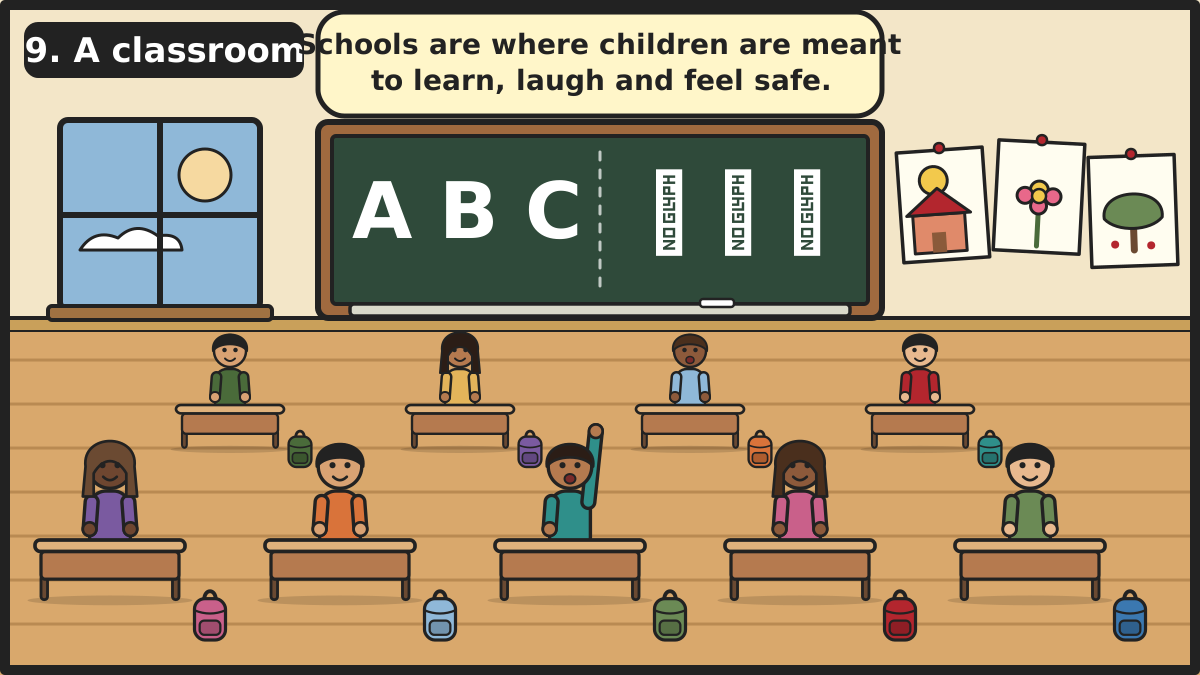
A bright classroom with a window and a blackboard that shows the letters A B C on one side and three Arabic letters on the other. Children of different skin tones and hair sit at two rows of small wooden desks, smiling, one with a raised hand, with colourful backpacks on the floor beside them. Three children's drawings of a house, a flower and a tree are pinned to the wall. A caption box says schools are where children are meant to learn, laugh and feel safe.
Schools are where children are meant to learn, laugh and feel safe. Gaza's health ministry, which operates under the de facto authorities, had fully identified 74,237 deaths as of 7 October 2026. Of those, 21,976 were children, according to the UN humanitarian office's snapshot of 4 November 2026. OCHA says numbers the UN has not verified are attributed to their source. UNICEF's report for January to March 2026 counts at least 21,500 children killed and at least 41,200 injured up to 31 March. UNICEF's report to 30 June 2026 says 277 children were reported killed after the ceasefire of 10 October 2025, and OCHA's report of 22 October 2026 cites UNICEF for 351 children killed since the ceasefire was announced.
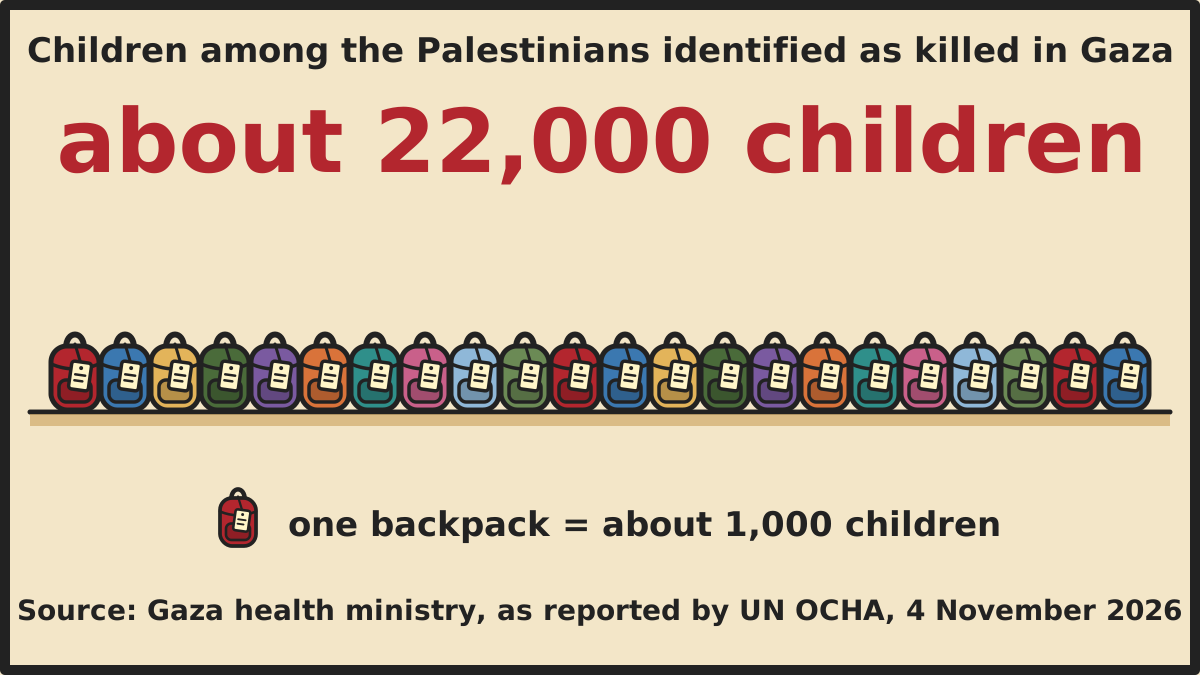
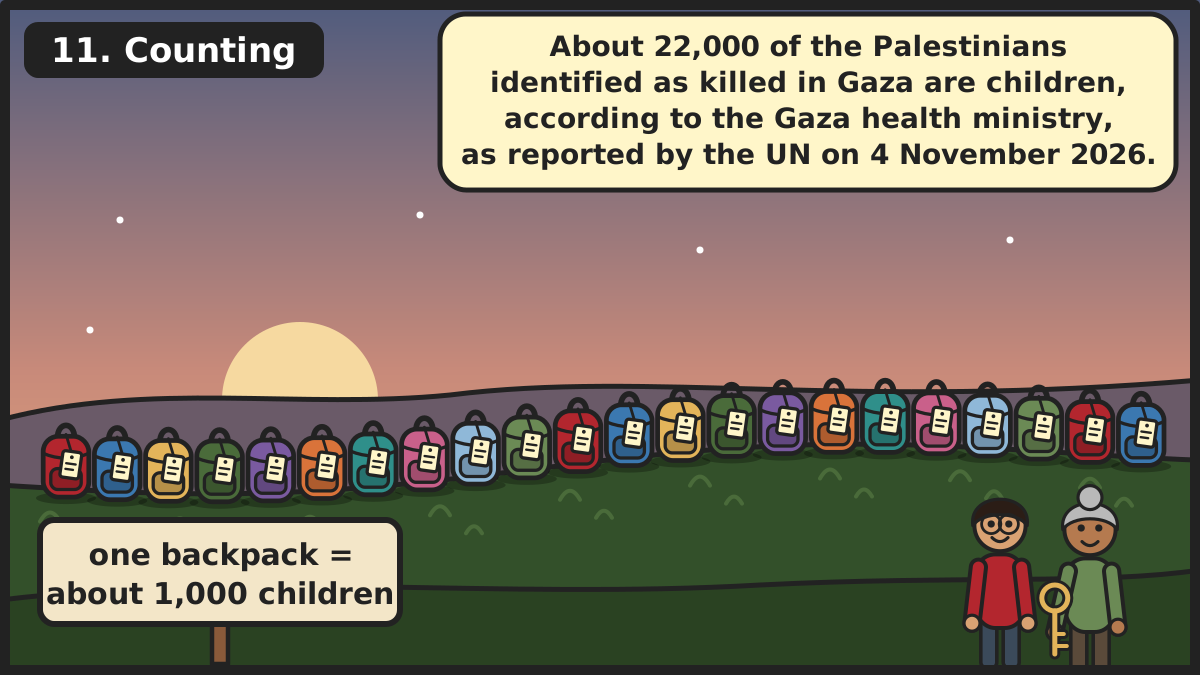
Animated counter graphic. Twenty-two school backpacks with tags appear one by one in a row while a large number above rises from 0 to about 22,000 children. A key says one backpack equals about 1,000 children. The source line reads Gaza health ministry, as reported by UN OCHA, 4 November 2026. The animation pauses on the final count and then repeats; with reduced motion it shows the final count.
Each backpack stands for about 1,000 children: about 22,000 of the Palestinians identified as killed in Gaza are children, according to the Gaza health ministry as reported by UN OCHA on 4 November 2026. The UN's own verified counts are lower, because verification is slow. The Secretary-General's annual report on children and armed conflict, dated 17 June 2026 and covering 2025, says the UN verified the killing of 2,668 children in Gaza that year and received reports of 4,588 more that were pending verification. It warns that access problems mean its figures understate the scale. The UN Commission of Inquiry, in a paper dated 18 June 2026, said the number killed and injured is "certainly higher" than reported. It counted 20,179 children killed and 44,143 injured between 7 October 2023 and 7 October 2025, including 5,031 children under five. Other harms have their own counts. OCHA cites UNICEF (October 2026) for 60,000 children who have lost one or both parents. The commission estimated that 17,000 to 18,000 children were unaccompanied or separated from their parents by October 2025, and it recorded that Gaza's health ministry counted about 846 children with amputations by 5 April 2025. On hunger, the Secretary-General's report records 113 child deaths from malnutrition in 2025, and says Israel prevented humanitarian aid and commercial supplies from entering Gaza for 11 weeks between March and May of that year.
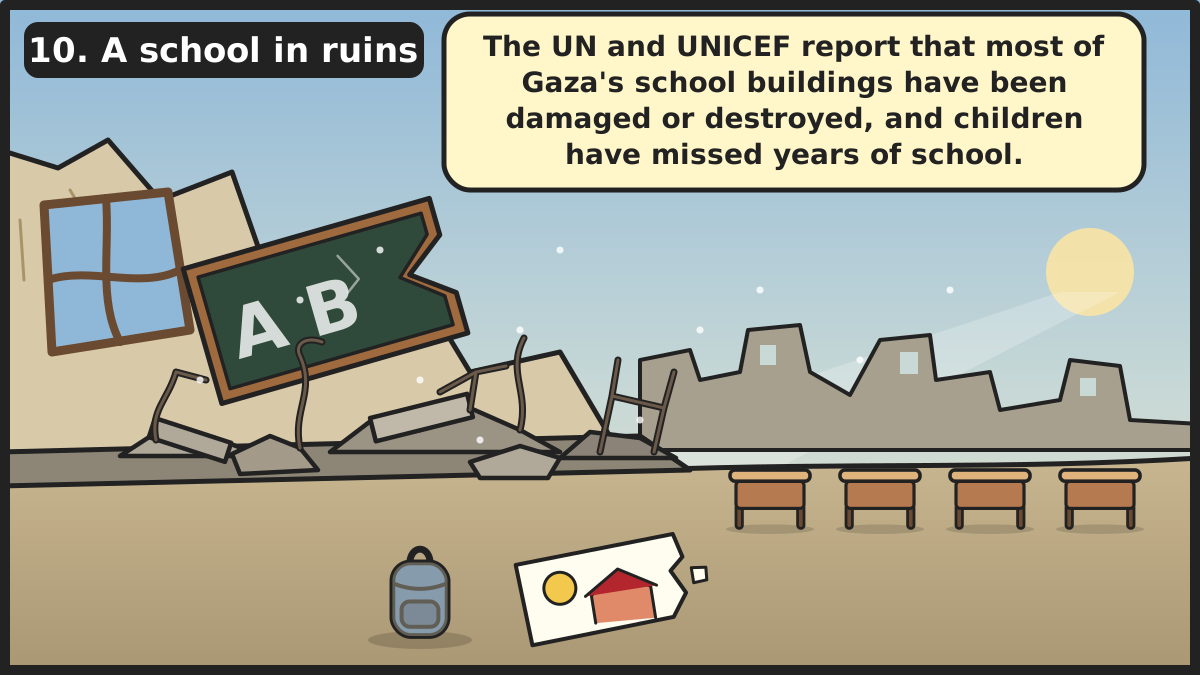
The same kind of classroom as a ruin under an open sky: a broken wall with a bent window frame, a blackboard leaning at an angle with only the letters A and B still visible, piles of rubble and bent metal frames, and dust floating in a shaft of light. In the foreground one small backpack and a torn child's drawing of a sun and a house lie on the ground, and four empty desks stand in a row outside. No people are shown. A caption box says what the UN and UNICEF report about Gaza's school buildings.
The UN and UNICEF report that most of Gaza's school buildings have been damaged or destroyed, and children have missed years of school. Schools are mostly unusable. OCHA says 526 of 564 school buildings, about 93 percent, need full reconstruction or major repair. The Secretary-General's report says Gaza's schools have been closed since 7 October 2023, which affects 637,500 children. In September 2026 the UN education cluster counted about 200,000 children with no structured learning. On 22 November 2023, UNICEF's executive director Catherine Russell told the Security Council, "today, the Gaza Strip is the most dangerous place in the world to be a child." UNICEF's regional director, Edouard Beigbeder, said on 6 August 2026 that a ceasefire that leaves an average of one child dead every day "is failing children." That release names no party.
A row of 22 colourful school backpacks, each with a small paper tag, stands along a green hillside at sunset with a low sun and the first stars. A wooden sign at the lower left reads one backpack equals about 1,000 children. The teenage narrator and the grandmother holding a golden key stand quietly at the lower right. A caption box says about 22,000 of the Palestinians identified as killed in Gaza are children, according to the Gaza health ministry as reported by the UN on 4 November 2026. No children are shown.
About 22,000 of the Palestinians identified as killed in Gaza are children, according to the Gaza health ministry as reported by the UN on 4 November 2026. The Secretary-General keeps a list of parties that commit grave violations against children. In the annex to the 2026 report, the Israeli armed and security forces are listed for killing and maiming children and for attacks on schools and hospitals. Hamas' Izz al-Din al-Qassam Brigades and affiliated factions, and Palestinian Islamic Jihad's Al-Quds Brigades, are listed for killing and maiming and for abducting children. The 2025 report, covering 2024, carries the same listings. For 2025 the report attributes 150 of the 2,668 verified child killings in Gaza to Israeli forces so far, with attribution of the other 2,518 still under way. It says most incidents involved explosive weapons in populated areas used by Israeli forces. The Secretary-General wrote that he was "gravely alarmed by the staggering increase in grave violations against children perpetrated by Israeli armed and security forces" and urged Israel to sign an action plan with the UN. He also urged Hamas and Islamic Jihad to sign action plans. The report verified nine military uses of schools and health facilities across Israel and the occupied territory: four by Israeli forces, three by Hamas and two by other Palestinian armed actors. The commission's paper adds that 40 Israeli children were killed on 7 October 2023 and that Hamas-led fighters abducted children, several of them alone. On Gaza, it found that Israeli security forces have "consistently, directly and intentionally targeted individual children", and it called that targeting deliberate, citing single precision gunshot wounds and weapons that give operators a clear view of the target. It found this amounted to the crime against humanity of persecution on the ground of age, and repeated its earlier finding of genocide. The commission is an investigative body, and no court has made these findings. Israel did not answer its 13 requests for information. Israel's UN ambassador, Danny Danon, called the paper "a political blood libel disguised as a U.N. document." The International Criminal Court found on 21 November 2024 reasonable grounds that Benjamin Netanyahu and Yoav Gallant deprived Gaza's civilians of food, water and medicine, with deaths "including children due to malnutrition and dehydration." A warrant is not a verdict. Children have died in the war between Iran and the United States and Israel too. On 28 February 2026, in the opening hours of the US and Israeli attack on Iran, the Shajareh Tayyebeh Primary School in Minab, in southern Iran, was struck between about 10:30 and 11:30 in the morning. The UN fact-finding mission on Iran reported on 21 September 2026 that the school, for girls and boys aged 6 to 13, stood in its own walled compound about 72 metres from a Revolutionary Guard naval complex, and that no information indicated it was used for military purposes. The counts differ. The local prosecutor announced 156 dead on 9 April 2026, including 120 schoolchildren and 26 women educators. The mission cited independent information of 157 dead including 123 children. The mission found reasonable grounds that the United States carried out the strike, with a Tomahawk missile. It also concluded that the school building was the intended point of impact and that the damage did not come from an errant strike on the neighbouring base. The New York Times and Reuters reported in March that a preliminary US military inquiry pointed to American responsibility, after targeting data that was out of date. Admiral Brad Cooper, the head of US Central Command, said on 19 May that the preliminary findings "correlated" the school strike with a US strike. Israel's military told CBS News in March it had found no connection to its operations. The Pentagon had not released its findings as of 5 November 2026, Military Times reported, and the mission said the United States had not replied to its requests for information. President Trump said in June, "Nobody did that on purpose." The mission found that the United States failed to do everything feasible to verify that the building was a military objective, and that it acted with recklessness, which "went beyond mere negligence." It did not find that anyone aimed at the children. No court has ruled, and no investigation published so far has found the strike deliberate. Two courts are involved, and they ask different questions. The International Court of Justice (ICJ) in The Hague judges states. The International Criminal Court (ICC) prosecutes individuals. In the ICJ, South Africa accuses Israel of breaching the Genocide Convention. In orders of 26 January, 28 March and 24 May 2024 the Court said the rights South Africa asserts are plausible and ordered emergency "provisional measures". Israel must prevent acts covered by the Convention, punish incitement, allow aid and preserve evidence. In May the Court also ordered Israel to halt its Rafah offensive if it risked conditions that could destroy the Palestinian group in Gaza. Those orders are binding and remain in force. The Court has not decided whether genocide happened. That belongs to the merits, which have barely begun. Israel filed its defence in March 2026, with objections that the Court lacks jurisdiction. An order of 21 May 2026 gave South Africa until 22 November 2027 to reply and Israel until 22 May 2029 to answer, with no hearing date set. At the ICC, judges issued arrest warrants on 21 November 2024 for Prime Minister Benjamin Netanyahu and former defence minister Yoav Gallant. They found reasonable grounds to believe both bore responsibility for the war crime of starvation as a method of warfare and for crimes against humanity including murder and persecution, between 8 October 2023 and 20 May 2024. A warrant was also issued for Hamas military chief Mohammed Deif, and it was later withdrawn after reports of his death. Israel calls the ICJ case baseless and denies the ICC charges. It is not a member of the Court and disputes its jurisdiction. In April 2025 the Appeals Chamber sent that challenge back to the lower chamber, and no final ruling on it had been found as of November 2026. The warrants stand. Prosecutor Karim Khan, who applied for them, was removed by member states in July 2026 over allegations he denies. An expert quoted in that report said the removal does not cancel the warrants. No court has. Several bodies have said so. The UN Independent International Commission of Inquiry on the Occupied Palestinian Territory reported on 16 September 2025 that "genocide is occurring in Gaza and is continuing to occur." It found Israeli authorities and forces committed four of the five genocidal acts listed in the 1948 Convention, and it said Israel's president, prime minister and former defence minister incited genocide. It is an investigative body appointed by the UN, not a court. Amnesty International reached a genocide finding on 5 December 2024. Human Rights Watch said on 19 December 2024 that cutting off water amounted to "acts of genocide", a narrower claim. In July 2025 the Israeli groups B'Tselem and Physicians for Human Rights Israel became the first major Israeli organisations to use the word. On 1 September 2025 the International Association of Genocide Scholars passed a similar resolution with 86 percent of voters in favour, though only about 28 percent of members voted. Israel rejects every one of these findings. It says harm in war is not proof of intent to destroy a people, and Germany and the United States have also said they reject the label. In plain terms, war crimes are serious breaches of the rules of war, such as attacking civilians or starving them as a tactic. Crimes against humanity are widespread or systematic attacks on civilians, such as persecution. Genocide needs one more element: intent to destroy a national, ethnic, racial or religious group, in whole or in part. That intent is the hardest thing to prove, which is one reason courts take years. The ICJ needed 14 years to rule on Bosnia's genocide case against Serbia, from 1993 to 2007. Spain, Ireland and Norway recognised Palestine in May 2024, followed by Slovenia and Armenia. In September 2025 the United Kingdom, Canada, Australia and Portugal did so, then France, Belgium (with conditions), Luxembourg, Malta, Monaco and Andorra. Trackers count roughly 150 to 157 of 193 UN members, depending on who counts. At the UN, the General Assembly voted 124 to 14, with 43 abstentions, on 18 September 2024 to demand an end to Israel's presence in the territories within 12 months. On 12 September 2025 it endorsed the New York Declaration on a two-state solution, 142 to 10. These votes are not binding. The Security Council backed a US-drafted Gaza plan on 17 November 2025, 13 to 0, with Russia and China abstaining. On arms, the United Kingdom suspended about 30 of 350 export licences in September 2024 and Canada stopped new permits in March 2024. Pakistan does not recognise Israel, and its Foreign Office said in January 2026 that Pakistan will not join the Abraham Accords. Foreign Minister Ishaq Dar told a two-state conference in September 2026 that the occupation "must stop, and stop immediately", repeating the call for a Palestinian state on pre-1967 borders with East Jerusalem as its capital. Pakistani press reports say its 28th relief consignment, 100 tonnes of tents, left for Gaza via Egypt on 9 February 2026, bringing its total to 2,727 tonnes. Rumours about Palestine and Israel often attach to the Jeffrey Epstein case, so it is worth separating what the court record shows from what it does not. Jeffrey Epstein was an American financier and convicted sex offender. In 2008 he pleaded guilty in a Florida state court to prostitution charges that involved a girl under 18, and he served 13 months under a federal non-prosecution deal that the Justice Department's ethics office criticised in 2020 as poor judgment. He was arrested on federal sex trafficking charges on 6 July 2019 and died in custody on 10 August 2019. New York's medical examiner ruled it a suicide. His longtime associate Ghislaine Maxwell was convicted in December 2021 of sex trafficking offences and sentenced on 28 June 2022 to 20 years in prison. The US Supreme Court declined to hear her appeal on 6 October 2025. In November 2025 the House voted 427 to 1 for the Epstein Files Transparency Act, and President Trump signed it on 19 November. It ordered the Justice Department to release its unclassified Epstein records within 30 days. After a first release in December, the department announced on 30 January 2026 more than 3 million further pages, about 2,000 videos and 180,000 images. The files are a large mix of emails, photographs, news clippings and raw tips sent to the FBI by the public. A name in them can mean a friend, a journalist, a lawyer, or someone mentioned in passing, and appearing in a document is not evidence of a crime. In July 2025 the Justice Department and FBI said they had found no incriminating "client list" and no credible evidence that Epstein blackmailed prominent people. No court, official investigation or major news report found for this guide has established that Epstein worked for any country's intelligence service. Rumours of that kind are used to blame Jews as a group. The ADL's Center on Extremism reported a rise in such conspiracy theories in 2025, as JTA described. That blame is false, because the crimes belong to the people convicted of them. Falsehoods come from every side. Full Fact found on 9 October 2024 that a viral image of 20 burning tents in Gaza was a screenshot from an artist's video, made in July 2024 and labelled AI. On 26 November 2023 Human Rights Watch said it could not corroborate the Gaza health ministry's figure of 471 deaths at al-Ahli hospital, noting the al-Shifa hospital's director had estimated about 250. It judged a misfired rocket the likely cause and called for an independent investigation. In May 2024 Meta and OpenAI said they had removed a network run by an Israeli marketing firm, STOIC, whose fake accounts posed as Jewish students and African Americans. On 11 March 2026 AAP FactCheck, with AFP, debunked footage of a French festival crowd from June 2025 sold as Israelis fleeing Iranian missiles. The Epstein case shows why sorting matters. Court records, claims without proof and claims that spread hate need to be kept apart, as the diagram shows.
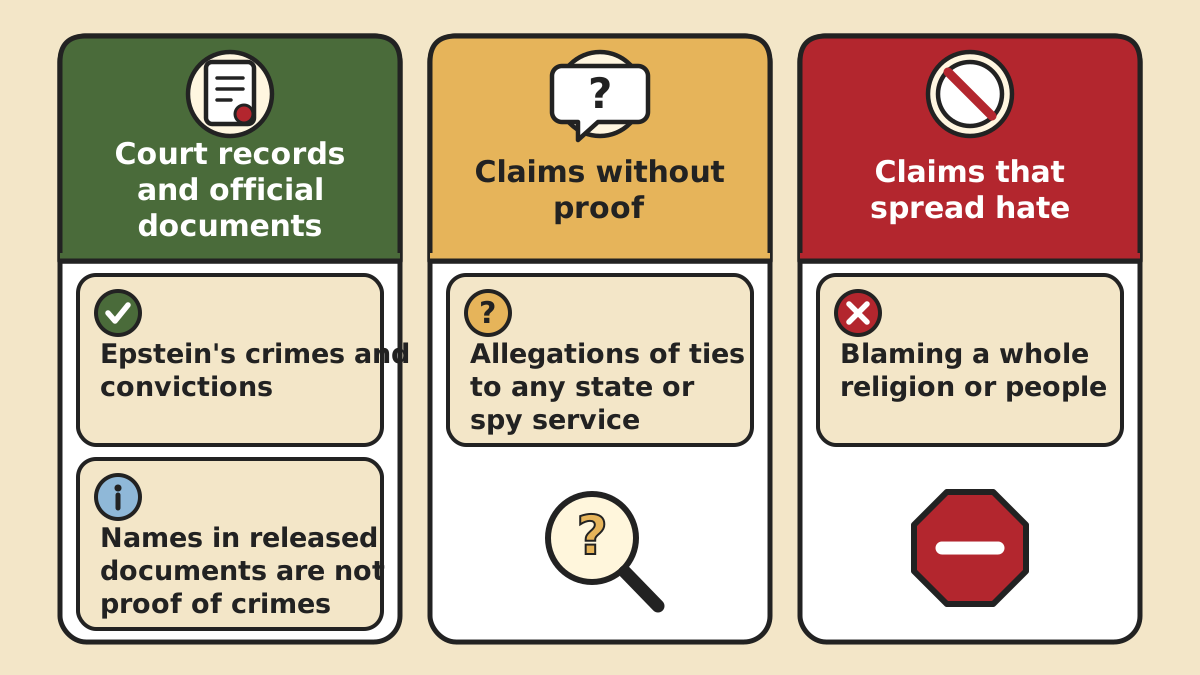
Three columns with icons that sort claims. Court records and official documents lists Epstein's crimes and convictions, and that names in released documents are not proof of crimes. Claims without proof lists allegations of ties to any state or spy service. Claims that spread hate lists blaming a whole religion or people. The columns appear one after another.
Sorting what is documented from what is unproven and from what is plain hate keeps a rumour from being treated as a fact.
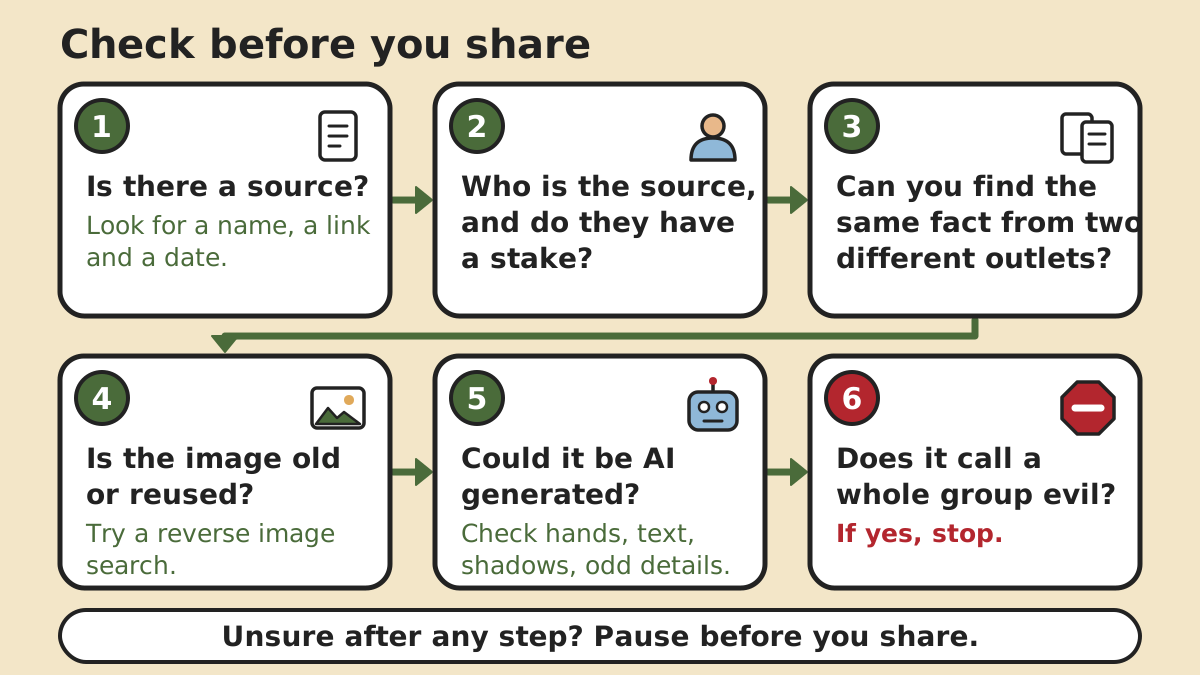
Animated flowchart titled Check before you share, with six numbered boxes that light up one by one: is there a source, who is the source and do they have a stake, can you find the same fact from two different outlets, is the image old or reused (try a reverse image search), could it be AI generated (check hands, text, shadows, odd details), and does it call a whole group evil (if yes, stop). A banner at the bottom says to pause if you are unsure after any step.
Six quick questions to ask before you share anything about this conflict, ending with a hard stop for content that calls a whole group evil. The habits are in the flowchart above. Ask who the source is and what stake they have. Look for the same fact from two independent outlets. Run a reverse image search to see if the picture is old. Check for signs of AI, such as odd hands, garbled text and wrong shadows, and remember that real footage is sometimes wrongly dismissed as fake. The wider problem of fake media is covered in the post on the future of AI, its benefits and its risks. If a post says a whole people or faith is evil, stop. No verifiable source for this quote has turned up. The wording changes from post to post. A common version reads "I would have killed all the Jews of the world, but I kept some to show the world why I killed them." Searches for this guide found no speech, letter, diary entry or published record that contains it, and it appears to be a modern internet quote. No published check of this exact wording by Reuters, AFP, Snopes, PolitiFact or Full Fact turned up either, so none of them can be cited as ruling on it. The closest analysis found is a blog post, which is not a fact-checker. It says it found nothing like the line in Hitler's Reichstag speeches. Fact-checkers have taken apart other invented Hitler lines, such as a PolitiFact check from December 2022. What is documented is plain. On 20 January 1942 senior Nazi officials met at Wannsee, near Berlin, to coordinate what they called the Final Solution. Reinhard Heydrich put the number of Jews in Europe at about 11 million, according to the US Holocaust Memorial Museum. The aim was to kill every Jew the regime could reach, and the crime is recorded in Nazi Germany's own documents, trial evidence and survivor testimony. Fake quotes spread because they read like a confession. This one recasts a genocide as something its victims brought on, which is the claim Nazi propaganda made. Reposting it, whatever the intent, helps that idea along. The case against the Israeli government's conduct rests on documents that can be checked, and it gains nothing from a line nobody can source. Phones and the internet are how people in Gaza find out where it is safe, reach relatives and show the world what is happening. They have also been cut off repeatedly. On 12 June 2025 Gaza lost all internet and landline service after the last main fibre cable was severed during Israeli bombardment. NetBlocks, which monitors internet access, recorded the disruption. The Palestinian telecom regulator blamed systematic targeting of communications infrastructure and said Israel blocked repairs. The report carried no Israeli response. Online, Palestinian users have complained of silenced posts. In December 2023 Human Rights Watch published Meta's Broken Promises, which examined 1,050 cases of removed or restricted content on Instagram and Facebook. In 1,049 of them the content was peaceful and supported Palestine, and one removed content supporting Israel. HRW said the cases were not a representative sample, but concluded the censorship was systemic. Meta told HRW that in conflicts it "may not always be able to review everything based on our review capacity". Surveillance and targeting raise the most serious questions, which the post on AI surveillance and data privacy covers more generally. Amnesty International reported in May 2023 that a facial recognition system called Red Wolf scans Palestinians at checkpoints in Hebron. In April 2024 the Israeli outlets +972 Magazine and Local Call, citing six intelligence officers, reported that an AI system called Lavender marked about 37,000 Palestinians as suspected militants. The Israeli army called such tools auxiliary, said an analyst must independently verify every target, and denied keeping a kill list. These are anonymous-source reports and the army disputes them. Tech workers have pushed back, a pattern also seen in the AI backlash and public opposition post. Google and Amazon won the $1.2 billion Project Nimbus cloud contract with the Israeli government in 2021. Google says it covers commercial cloud workloads and is "not directed at highly sensitive, classified, or military workloads"; Amazon declined to comment. Press reports say Google dismissed 28 employees after sit-ins in April 2024, and the campaign group involved called it retaliation.
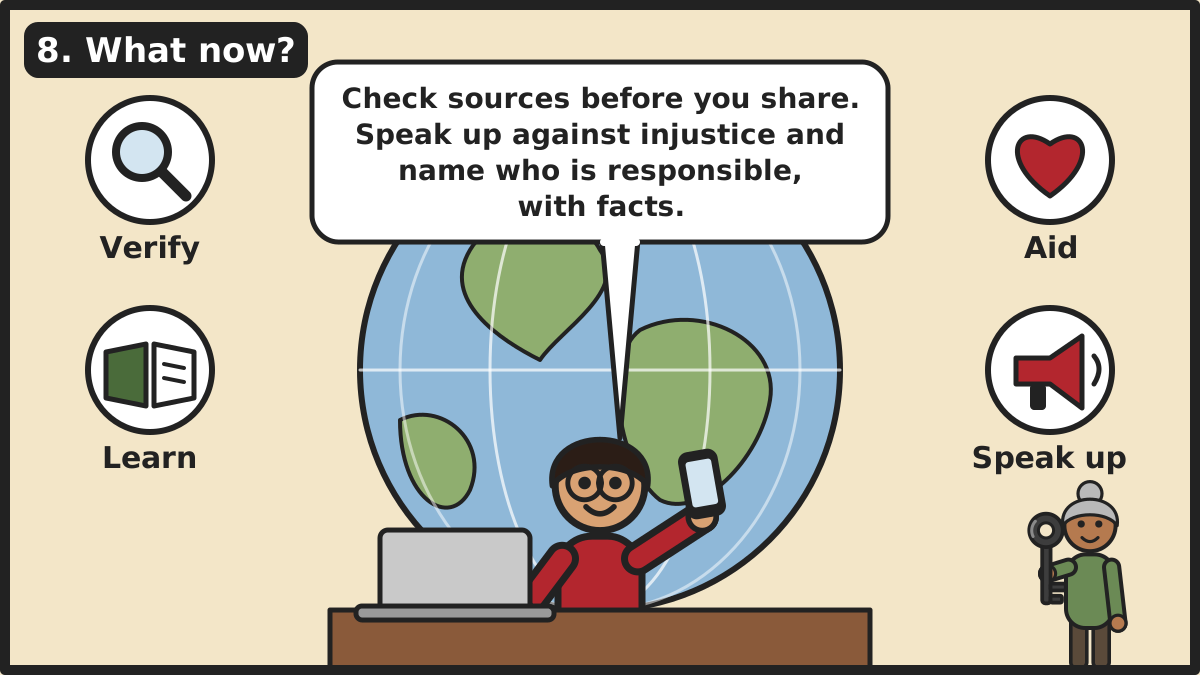
The teenage narrator in a red hoodie sits behind a desk with a laptop, holding up a phone in front of a large globe. Four round icons surround the scene: a magnifying glass labelled Verify, a heart labelled Aid, an open book labelled Learn and a megaphone labelled Speak up. The grandmother with the old key stands at the lower right. A speech bubble says to check sources before you share, to speak up against injustice and to name who is responsible, with facts.
Understand the history. Check sources before you share. Support trusted aid groups. Speak up against injustice and name who is responsible, using documented facts. Developers can build things that are accurate. Make explainers in Urdu and Arabic that cite sources and dates. Publish timelines in open formats with a link to the source behind every row. Evidence is a skill, and untrained collecting can damage it. Groups such as Mnemonic archive footage by hashing files so tampering is detectable, working from the Berkeley Protocol on digital open-source investigations, and Bellingcat and Forensic Architecture publish their methods. Verify before you share, and pass material to such groups rather than hosting raw footage. Gaza's freelancers need clients. Unemployment there is 85 percent, according to The National citing the ILO, and Gaza Sky Geeks, run by Mercy Corps, trains freelancers and takes mentors through its website. The National reported in August 2026 that getting paid is hard because cash and bank access are limited. Pay full rates, pay on time and ask which platform the freelancer can actually withdraw from. Ask hard questions about procurement. If your employer buys cloud or AI services, ask what the vendor's human rights policy says and who audits it. Write to your own elected representative with specific requests. Peaceful campaigning is lawful in most places. One person cannot open a crossing or end a war. A verified donation can pay for food, medicine or a connection. Accurate sharing keeps misinformation from hurting the cause. Polite, specific messages to representatives are one of the few routes to policymakers. The limits are firm. Do not harass, doxx or hack anyone, including tech workers and company staff. Hate towards Jews or Muslims is wrong and harms the cause. Worries about a wider war are real too, and the post on World War 3 and technology looks at what credible sources say about that risk. A consumer boycott is a lawful choice, and a reminder is fair: spending is one of the few levers an ordinary person controls. It works best when it is accurate. Many viral lists are wrong, and the people hurt by a wrong list are often local staff. The Boycott, Divestment and Sanctions movement (BDS) was launched on 9 July 2005. Its own website says the call came from 170 Palestinian unions, refugee networks, women's organisations and other civil society bodies. It asks for pressure on Israel until three demands are met: ending the occupation of Arab lands and dismantling the West Bank barrier, full equality for Palestinian citizens of Israel, and respect for the right of Palestinian refugees to return, as set out in UN Resolution 194. The movement's current corporate guide is titled Guide to BDS Boycott and Pressure Corporate Priority Targeting. It carries a publication date of 6 December 2024 and mentions events from 2025, but shows no later update date. This section reads the page as it stood on 8 November 2026. The guide says the movement "targets complicity, not identity", and it picks a short list of companies for research-backed complicity, brand recognition and the chance of success. The same page adds a second position. It says that, as far as the movement knows, no Israeli company is both free of involvement in the occupation and publicly supportive of Palestinian rights under international law, so it calls for boycotting all Israeli companies unless they meet those conditions. "Israeli-made" describes where a product comes from. "Named by BDS" describes a company the movement calls complicit, and most of those are not Israeli at all. The list below groups the names. The first group is copied from the BDS page. The second is Israeli-origin brands that people commonly name, with ownership checked in 2026. The third is what to look for on labels.
Text
1. COMPANIES ON THE BDS MOVEMENT'S OWN LIST (guide of 6 December 2024)
Consumer boycott priority targets:
  Chevron (including Caltex and Texaco), Intel, Dell, Siemens,
  Hewlett Packard (HP Inc and HPE), Microsoft, Carrefour, AXA,
  Reebok, Disney+, Teva, SodaStream, RE/MAX,
  and Israeli produce in supermarkets
Organic targets (grassroots campaigns the movement supports):
  McDonald's, Coca-Cola, Burger King, Papa John's, Pizza Hut,
  Domino's Pizza, Wix
Pressure targets:
  Google, Amazon, Booking, Airbnb, Expedia

2. ISRAELI-ORIGIN BRANDS COMMONLY NAMED
SodaStream: on the BDS list; owned by PepsiCo since December 2018
Sabra hummus: not on the BDS page; PepsiCo agreed in November 2024
  to buy the half that Strauss Group owned
Ahava (Dead Sea cosmetics): disputed for years over where it is made
Teva (generic medicines): on the BDS list
Strauss Group products: check the label

3. PRODUCTS TO CHECK LABELS FOR
Fruit, vegetables and wine labelled "Product of Israel" (BDS says
  some come from settlements)
EU labels that name a settlement as the place of origin
Barcode prefix 729: a clue to an Israeli-registered company only

NOT on the BDS page: KFC, Pepsi, Nestle, Starbucks, Sabra
Settlements are the sharpest part of the supply question. On 12 November 2019 the EU Court of Justice ruled, in case C-363/18, that foodstuffs from territories occupied by Israel must show their territory of origin, and must name the settlement when they come from one. No Pakistani rule of this kind turned up, so shoppers in Pakistan should not assume such a label exists. Barcodes help only a little. The prefix 729 is allocated to GS1 Israel, the national barcode body. GS1 says a prefix shows which member organisation issued the number and does not show where the product was made, as Full Fact reported on 15 November 2023. The viral claim that Israel switched to 871 to dodge boycotts is false, since 870 to 879 belongs to the Netherlands. Ownership changes, so check it. PepsiCo completed its SodaStream purchase on 5 December 2018. Strauss announced on 22 November 2024 that it was selling its half of Sabra to PepsiCo, and the Jerusalem Post reported the next day that PepsiCo had full ownership, though no closing announcement turned up. Ahava was bought by the Chinese group Fosun in 2015, and the Times of Israel reported at the time that the company might move its factory. Viral lists in Pakistan name McDonald's, KFC, Coca-Cola, Pepsi, Nestle and Starbucks together. Only McDonald's and Coca-Cola are on the official page, as organic targets, and Arab News noted in April 2025 that KFC is not officially on the list while Domino's is. Check any list against the source before you share it. Companies have answered. McDonald's chief executive Chris Kempczinski wrote on 4 January 2024 that several Middle East markets were seeing a "meaningful business impact due to the war and associated misinformation". He called the backlash "disheartening and ill-founded" and said restaurants are run by local owners. Yum Brands, which owns KFC, says it is non-political, and Starbucks says it has no political agenda. Sales evidence in Pakistan is thin. Coca-Cola Icecek, the Turkish bottler, reported Pakistan volume down 22.9% in the September 2024 quarter, which Bloomberg tied to boycott calls and a weak economy. Its FY25 release, dated 3 March 2026, says Pakistan returned to volume growth of 1.3% to 314 million unit cases after a 14.2% decline, and blames local brands, affordability and taxes without using the word boycott. PepsiCo's chief executive told Reuters in July 2024 that boycotts were affecting Lebanon, Pakistan and Egypt. Jobs and safety are the harder questions. A Pakistani franchise owner told Dawn in April 2024 that boycotts hurt local workers and suppliers more than large corporations. Reuters reported on 18 April 2025 more than ten mob attacks on KFC outlets and at least 178 arrests, and said one KFC employee was shot dead near Lahore, with the motive under investigation. Punjab's information minister, Azma Bokhari, said on 20 April 2025 that 25,000 Pakistanis work at such outlets. No audited Pakistani job-loss count has been published. On the law, no Pakistani statute restricting a consumer boycott turned up, though Pakistani legal databases were not searched directly. The arrests were for attacks on property and people, which are crimes. In Europe, the European Court of Human Rights ruled in 2020, in Baldassi v France, that convicting activists for urging a boycott of Israeli goods violated freedom of expression. Choosing not to buy something is a lawful consumer choice, and damaging an outlet or threatening its staff is not. A sensible checklist runs like this. Start from the official BDS page and read why a company is named. Check who owns a brand today. Treat barcodes and viral screenshots as clues until you find a dated source. Leave staff alone, because they are neighbours who did not make the company's decisions. Pair any boycott with something that helps directly, such as a verified donation. Every group below has its own official page for Palestinian relief, and each page opened in a November 2026 check. What follows is what each group says about itself. The author cannot vouch for any organisation beyond its own pages and public registers, and the list is not exhaustive. Access is the first thing to know. Israeli laws that took effect in January 2025 bar UNRWA from operating in Israeli territory and East Jerusalem, and Israel's registration rules for international aid groups have changed who can work in Gaza and the West Bank. Several groups below describe the effects themselves. United Nations and Red Cross bodies:
  • UNICEF revised its State of Palestine appeal in September 2026. It says aid delivery increased after the October 2025 ceasefire, and that gains in food security and nutrition remain "fragile and uneven".
  • UNRWA serves Palestine refugees and has a donation form for them. Its main website refused automated checks. Arab News reported on 3 April 2026 that UNRWA officials warned of service cuts under a funding crisis and that Israeli laws had hampered its work.
  • The ICRC says its Red Cross field hospital in Rafah, open since May 2024, was expanded to 72 beds in 2026. It also says restrictions on what can enter Gaza make the work extremely difficult.
  • The Palestine Red Crescent Society says it sent nine trucks carrying more than 3 million units of medicine to Gaza on 24 February 2026. Its donation page is linked from its site.
  • The World Food Programme says about 1.4 million people in Gaza face crisis-level hunger or worse. It says it needs US$450 million up to March 2027 for Gaza and the West Bank, and its page links to a donation form.
Medical and humanitarian charities:
  • Médecins Sans Frontières runs hospitals and clinics in Gaza and mobile clinics in the West Bank. It says its Israeli registration expired on 31 December 2025, so it cannot send supplies or international staff, and its Palestinian teams keep working.
  • Medical Aid for Palestinians is a UK charity (number 1045315). It says its mobile clinics reach 40 isolated West Bank communities and it has a 100 percent Zakat policy.
  • Anera posts monthly response logs, the latest dated 1 November 2026, on its work in Gaza and the West Bank.
  • Oxfam GB (charity number 202918) updated its appeal on 19 October 2026. It says 9p of each pound goes to support and running costs, and that it works despite "punitive registration requirements".
  • Save the Children says it and its local partners have supported over a million children in the occupied territory despite access limits.
Muslim charities:
  • Islamic Relief says it has supported Palestinians since 1997 and lets you mark a gift as Zakat. It says Israeli registration limits are severely impeding its response.
  • Human Appeal says it has delivered aid in Gaza since 1991 and runs a 100 percent donation policy. Its page gives England and Wales charity number 1154288.
  • Alkhidmat Foundation is the Pakistani option. It reports 7,580 tons of relief worth PKR 10.51 billion since October 2023, which are its own figures, and takes cards, bank deposits and mobile wallets. It lists several bank accounts, so confirm account details with Alkhidmat before transferring.
Some groups are left out because their pages could not be confirmed. Muslim Aid blocked automated checks, the WHO Foundation and Pakistan Red Crescent pages did not load, and the Edhi Foundation's site does not mention Gaza. Connectivity has its own appeals. Connecting Humanity, a charity registered in Portugal, gives eSIMs to people in Gaza and says it has donated over 450,000, which is its own figure. Use only the donation links on connecting-humanity.org. Ratings help. Charity Navigator pages for UNICEF USA, Doctors Without Borders USA, Save the Children, Oxfam America and Anera each showed 4 of 4 stars in November 2026. Those are the US entities, and a rating for one country says nothing about another country's branch. Use these six rules.
  1. Type the website address yourself. Never use a link from a message, a comment or an unknown account.
  2. Find the group on a register. In England and Wales use the Charity Commission register. In the US use the IRS Tax Exempt Organization Search at irs.gov. In Pakistan use the Pakistan Centre for Philanthropy lists at pcp.org.pk/npo-directory and pcp.org.pk/ingo-directory. Certification there is a separate process, so absence from the list proves nothing.
  3. Pay by card or bank transfer to an account in the organisation's own name. Refuse gift cards, crypto and payments to a person.
  4. Distrust urgency and look-alike names. The Edhi Foundation's site lists several fake domains copying its name.
  5. Ignore donation drives on social media or messaging apps unless you can trace them to the charity's own site.
  6. Keep the receipt and check your statement for recurring charges.

The US Federal Trade Commission also advises searching a charity's name with the word scam, and reporting fraud to your state regulator. This section is personal. I am a final-year Computer Science student in Pakistan, not a historian or a lawyer, and I read and compared sources for this guide as a student would. My view is that Palestinians deserve safety, equal rights and dignity, and that the documents above, from the ICJ opinion to the UN's own counts, show why that case needs no exaggeration. I also think wrongdoing deserves to be named. Where courts, UN bodies and investigators have identified who is responsible for the deaths of civilians and children, readers have a right to know that, in plain words and with the source. Some questions stay open for me: why exactly each family left in 1948, whether the courts will find genocide, and how Israeli security and Palestinian rights can both be met. I would change my mind on a specific point if a court or a well-sourced investigation contradicted a figure or finding here. More about me is on my about page, and my projects are on my work page. If you find an error in this guide, send me a correction with a source and I will check it.
Share this post: